
Surrogate's Court in New York
In New York, the court that handles wills and estates is called the Surrogate's Court, not the Probate Court. Every county has one. Richmond County Surrogate's Court has authority over a range of matters that arise when a person dies or when a minor, incapacitated person, or absent person needs a court-appointed guardian. The court's authority covers probate of wills, administration of estates without a will, small estate procedures, and voluntary administration for qualifying estates.
The Surrogate's Court also handles guardianship petitions for minors and incapacitated adults, trust accountings, objections to wills and accounting, estate sales of real property, and adoption-related filings. Disputes among heirs, creditors, and fiduciaries can extend into contested proceedings that may include full hearings, citations, and court decrees. Surrogate Hon. Matthew J. Titone presides over Richmond County Surrogate's Court matters.
Adoptions are a separate authorized jurisdiction. Surrogate's Court adoption files are restricted, not open to the public. The court's mandate does not include divorce; that belongs to Supreme Court. Child support and custody are Family Court matters. But if a parent's death triggers a guardianship question for a minor child, that proceeding can come before the Surrogate.
For self-represented litigants, the Help Center is the starting point. Court staff in the Help Center explain forms, procedures, and local practice. They cannot choose your strategy or give legal advice, but they can help you understand what documents are needed and where to file.
Richmond County Surrogate's Court Contacts
The Surrogate's Court sits on Richmond Terrace in the St. George courthouse complex, near the Staten Island Ferry, Richmond County Family Court, and the nearby civic center. Clerks' offices are on the second floor, Room 201. The Records Room is in the basement, Room B-3. The court is open Monday through Friday, 9 a.m. to 5 p.m., but the Records Room keeps shorter hours, so plan your visit around those times.
Richmond County Surrogate's Court
18 Richmond Terrace
Staten Island, NY 10301
General Clerk's Office: 718-675-8500
Help Center: 718-675-8508
Law Department: 718-675-8505
Guardianship: 718-675-8510
Clerks' Offices: 2nd Floor, Room 201
Records Room: Basement, Room B-3
Records Room Hours: 10 a.m.-1 p.m. and 2 p.m.-4 p.m.
Court Hours: Mon-Fri, 9 a.m. to 5 p.m.
The court accepts filings by mail. Send papers and your contact information and email to Richmond County Surrogate's Court, 18 Richmond Terrace, Staten Island, NY 10301. The court also accepts electronic filings through NYSCEF. Free NYSCEF training is available through the court. Inquiries about calendared matters and conferences go to the Law Department at 718-675-8505.
Surrogate is Hon. Matthew J. Titone. Chief Clerk is Ronald M. Cerrachio. Deputy Chief Clerk is Alexandra Torres.
WebSurrogate Search Options for Richmond County Probate Records
WebSurrogate is the New York State public estate search system, run free by the Unified Court System. It covers Richmond County Surrogate's Court estate proceedings, public documents, and historical records. Access is free, and no login is required for public searches. The portal has five search modes, each suited to a different starting point.
The WebSurrogate welcome page lists each mode, explains access rules, and links to the public document retrieval system for filings on or after February 19, 2014. Start there before visiting the courthouse.
| Search Option | Type | How It Works |
|---|---|---|
| Name Search | Party name | Find Surrogate's Court files by party name; can be narrowed by date of death. |
| File Search | File number | Search by the court's file number if you already have it. |
| Old Index Search | Historical file number or name | Historical records; not all courts have every old record online. |
| Index Book Pages | Browse | Browse images of index book pages where available. |
| Will Search | Testator name | Search wills filed for safekeeping; these wills are not available for public view. |
The WebSurrogate page carries important notices. Wills filed for safekeeping are not public and do not appear in search results. Not all courts have every historical record available online. Links to document images are only for documents filed on or after February 19, 2014. For earlier unrestricted documents, you must view them on public-access computers inside the courthouse.
The WebSurrogate probate search portal is the starting point for any online Richmond County estate record lookup.
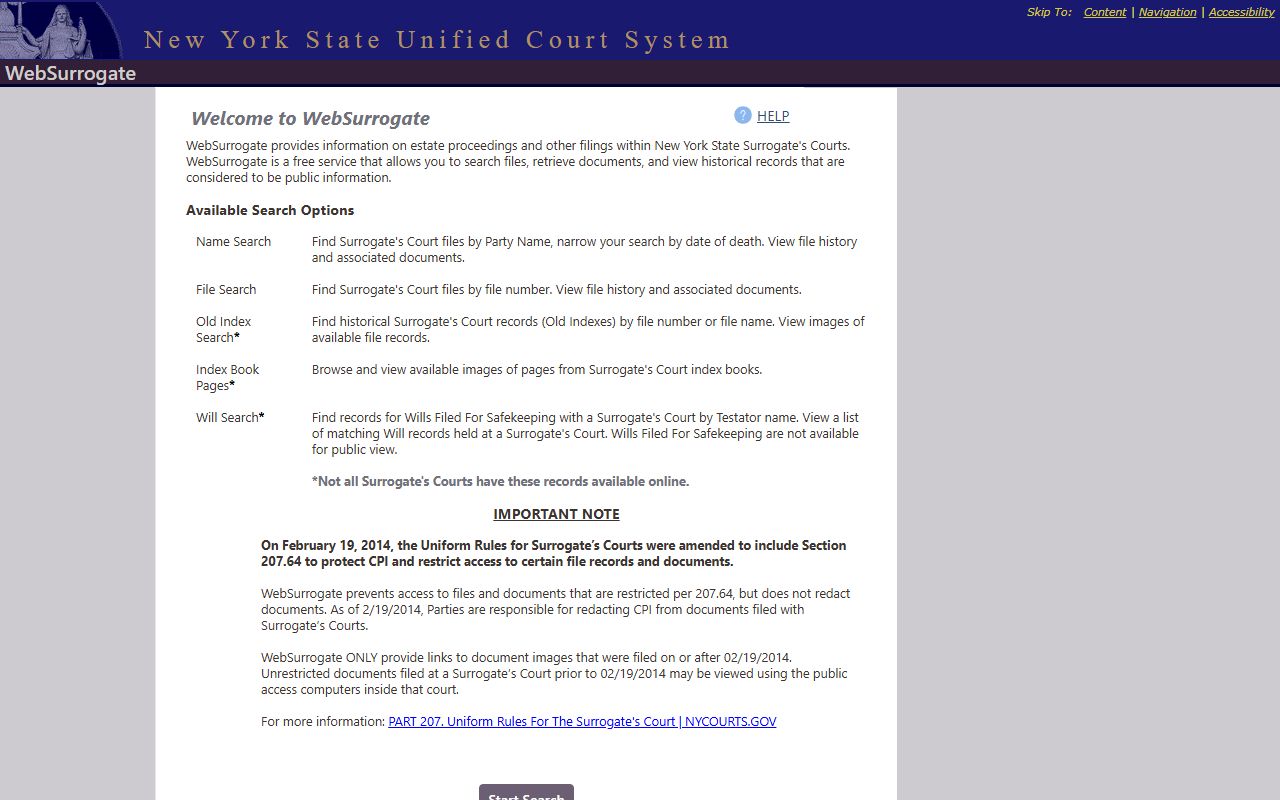
This view of the WebSurrogate portal shows the search options and the public-access notice about document image availability, which is critical for understanding what you can retrieve without visiting the Records Room.
Note: 22 NYCRR 207.64 protects confidential personal information in Surrogate's Court files. The system blocks restricted files and documents, but it does not redact documents itself; that is the filer's responsibility.Records Room Hours and In-Person Access
The Records Room is in the basement of 18 Richmond Terrace, Room B-3. It is open during two windows: 10 a.m. to 1 p.m. and 2 p.m. to 4 p.m. Those hours are shorter than the general court hours of 9 a.m. to 5 p.m., so arriving at 4:15 p.m. means you will not get in. Plan your visit to fall inside one of those windows, not just inside the court's general hours.
In-person access is the way to view documents filed before February 19, 2014 that are not available online. The Records Room also serves researchers, genealogists, attorneys, and estate parties who need the physical file or documents that were never digitized. Bring the file number, decedent's name, and approximate year of death to speed up the search. The clerks' offices on the second floor, Room 201, handle filings, procedural questions, and requests related to pending matters.
Older probate files can go back decades. Many historical records exist in paper form or as microfilm. Index books for older estates may be searchable through WebSurrogate's Old Index Search and Index Book Pages modes, but full document images for pre-2014 filings require an in-person visit or a formal copy request. If you are searching for a deceased relative's estate from the 1980s or earlier, count on the Records Room rather than the online portal.
Richmond County Surrogate's Court Estate Administration Steps
Estate administration in Richmond County follows a well-defined path whether or not the decedent left a will. The process begins with gathering information and ends with distribution of assets and, when required, a formal accounting. The court's role is to authorize the fiduciary, resolve disputes, and issue the orders that let an executor or administrator act.
- Gather the death certificate, the original will if one exists, a list of heirs and beneficiaries, an inventory of assets and debts, and the names of proposed fiduciaries.
- Determine whether the estate qualifies for small-estate or voluntary administration, or whether formal probate or administration is required. A Richmond Surrogate's Court brochure indicated a $50,000 or less threshold for small-property procedures; verify the current threshold with the court before filing.
- Prepare and file the petition and required supporting papers. File with Richmond County Surrogate's Court by mail to 18 Richmond Terrace, Staten Island, NY 10301, in person if available, or through NYSCEF where accepted.
- Pay the filing fee. Richmond Surrogate's Court fees are often set by statute based on the estate value. Contact the Clerk's Office at 718-675-8500 or consult the Surrogate's Court fee schedule before filing.
- The court reviews the papers. It may issue citations directing heirs or creditors to appear and show cause. Waivers and consents may be filed to avoid a hearing.
- If the papers are complete and the matter is uncontested, the Surrogate issues Letters Testamentary (when there is a will) or Letters of Administration (when there is no will). These letters give the fiduciary authority to act for the estate.
- The fiduciary marshals assets, provides creditor notice, pays debts and taxes, prepares an inventory, and files an accounting if required by the court or by statute.
- After all obligations are met, the fiduciary distributes the remaining estate to heirs or beneficiaries and files a final accounting or a decree closing the estate.
Contested matters, missing heirs, real estate sales, tax disputes, and complex trusts can lengthen this timeline significantly. The Law Department at 718-675-8505 handles calendared matters and conferences for pending proceedings.
Small Estates and Wills in Richmond County
Not every death triggers full probate. New York has a voluntary administration process for qualifying small estates. If the total property is under the statutory threshold and the assets are the right type, a distributee or person with an interest can file a small estate affidavit rather than a full probate or administration petition. Richmond County Surrogate's Court handles these filings at Room 201. For current eligibility limits and required forms, contact the Clerk's Office or use the Help Center.
Wills filed with the Surrogate's Court for safekeeping are a common point of confusion. Lodging a will for safekeeping does not probate it. The will is stored securely but is not public. WebSurrogate's Will Search finds wills filed for safekeeping by testator name, but the site states these wills are not available for public view. When the testator dies and a petition is filed, the court withdraws the will for use in the proceeding.
A will that has been admitted to probate and issued letters is part of the active court file and may be retrieved through WebSurrogate or by in-person request. The distinction matters: searching for a living person's deposited will yields no result because those wills are sealed from public view.
- Testator
- The person who makes a will; the decedent whose will is being probated.
- Executor
- The person named in a will to carry out its terms and administer the estate.
- Intestate
- Dying without a valid will; the estate is distributed under New York's laws of intestacy.
- Administration
- The court-supervised process for handling an intestate estate; an administrator is appointed rather than an executor.
- Guardianship
- Court-appointed authority over a person or property for a minor or incapacitated adult.
- Letters Testamentary
- The document issued by Surrogate's Court giving an executor authority to act for a testate estate.
Confidential Personal Information in Richmond County Surrogate's Court
Court rule 22 NYCRR 207.64 governs confidential personal information in Surrogate's Court filings. Filers are responsible for keeping sensitive personal data out of documents submitted to the court, including Social Security numbers, financial account numbers, and other identifiers that could enable identity theft or fraud. WebSurrogate blocks restricted files and documents from public view, but it does not redact documents that were filed without proper care. That means a misfiled document with confidential data may still appear unless the filer or court acts to restrict it.
The February 19, 2014 image cutoff is a direct result of rule changes protecting confidential personal information online. Documents filed on or after that date are linked in WebSurrogate's search results when they are public. Pre-2014 documents may exist in the court's file, but images are not served online. To view those older documents, use the Records Room computers at Basement Room B-3 during the 10 a.m.-1 p.m. and 2 p.m.-4 p.m. windows.
Adoption records in Surrogate's Court are restricted by statute and court rule. They are not searchable through WebSurrogate and are not produced for public inspection. Guardianship matters involving minors carry their own confidentiality protections. If you need a restricted record, consult with the Law Department or an attorney about whether a court order or formal application is required to access it.
Filing Fees and Certified Copies
Surrogate's Court filing fees in New York are often set by statute based on the gross value of the estate, so the fee for a large estate differs from the fee for a small one. Richmond County Surrogate's Court does not publish a single flat fee table for probate petitions. Contact the Clerk's Office at 718-675-8500 before filing to confirm the fee for your specific proceeding and estate size.
Certified copies of probate records are handled through the Richmond County Clerk, which sets the following fees for court records.
| Item | Amount |
|---|---|
| Plain copy, per page | $0.25 |
| Certified copy of a court record | $8 per document plus $0.25 per page |
| Certified copy of a county clerk record | $10 per document plus $0.25 per page |
| Surrogate / Adoption filing | $10 |
| Court records search, two consecutive years | $5 |
Probate copy requests may require identifying the specific document by file number and document name. Bring or state the decedent's full name, approximate year of death, and the file number if known. The Richmond County Clerk fee schedule governs court-record certified copies; the Surrogate's Court clerk handles filing and procedural fees.
Fee waivers may be available for people with financial hardship. Ask the Clerk's Office or Help Center for fee-waiver forms and eligibility rules before filing.
Surrogate's Court Help Center for Self-Represented Litigants
Richmond County Surrogate's Court runs a Help Center at 18 Richmond Terrace for people who do not have an attorney. The Help Center phone is 718-675-8508. Staff there explain court procedures, help identify the right forms, provide sample documents and handouts, and give referrals to outside resources. The Help Center has free Wi-Fi and access to court forms and DIY programs.
The Surrogate's Court Help Center page describes what the center provides and what to bring when you visit.
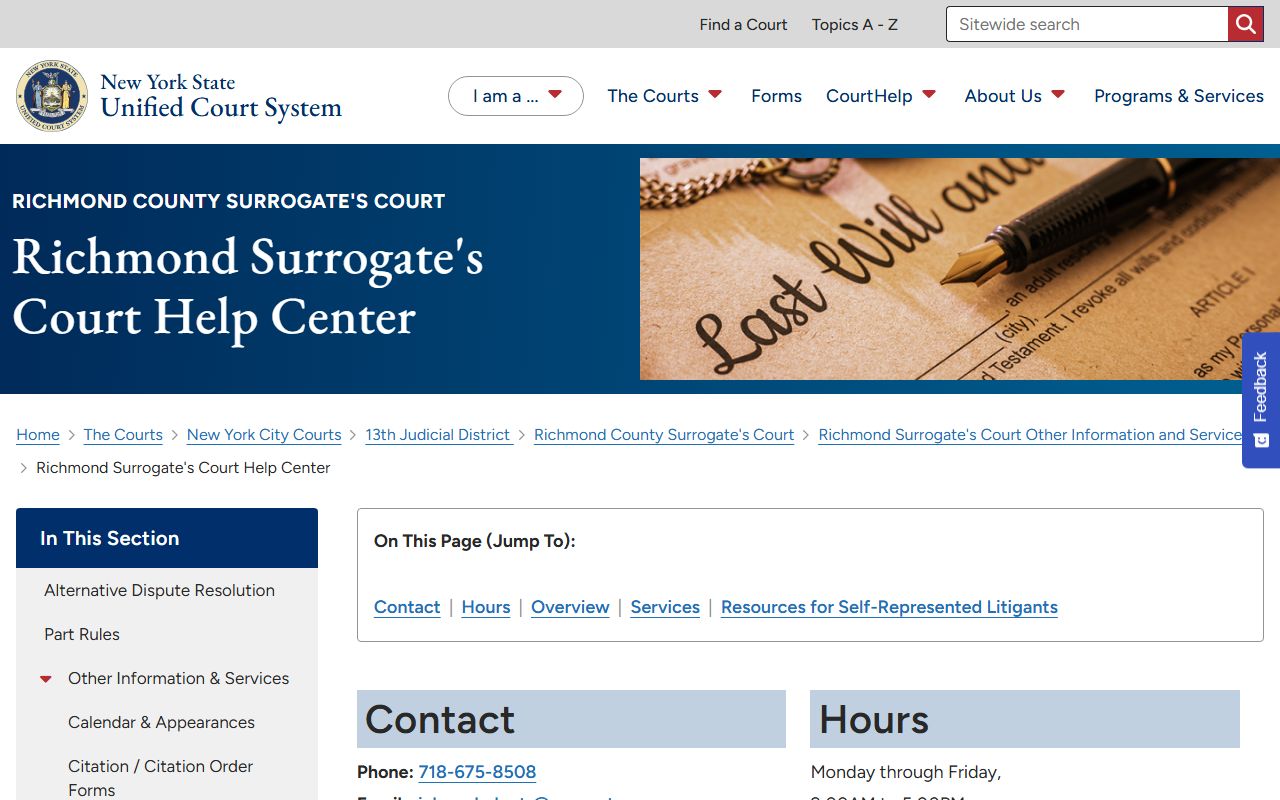
The Help Center page shows the range of procedural assistance available to estate parties who are handling filings without an attorney, including forms access and referral information for legal aid.
The Help Center cannot give legal advice. It cannot tell you whether you should file a will for probate or challenge a will, and it cannot represent you or help you draft legal strategy. What it can do is explain what a petition requires, show you the right form, and point you toward legal aid if you need it. LawHelpNY at lawhelpny.org is the statewide civil legal aid matching resource. Legal Services NYC at legalservicesnyc.org handles civil matters for qualifying city residents. The NYC Bar Association Legal Referral Service connects people to paid attorneys when free help is not available.
Note: E-filing through NYSCEF is generally not mandatory for unrepresented parties even where it is mandatory for attorneys. Ask the Help Center whether paper filing is right for your proceeding.
For related estate records and surrounding matters, see the marriage and divorce records page for Supreme Court divorce proceedings, the County Clerk page for certified copies and land-record searches, the main court records page for the full eCourts portal guide, and the FAQ for common questions about accessing Richmond County records.