
What Richmond County Civil Court Handles
New York City Civil Court, Richmond County branch, is a court of limited jurisdiction that handles civil matters within defined monetary and subject-matter limits. It sits under the New York State Unified Court System and operates as part of the NYC Civil Court structure for Staten Island. Cases that exceed these limits or require broader relief belong in Supreme Court, which has general jurisdiction. The Civil Court page at ww2.nycourts.gov describes the full court structure and case types for all NYC boroughs.
The three main parts of Richmond County Civil Court are General Civil, Housing Court, and Small Claims. General Civil handles money disputes up to $50,000, including consumer debt, contract claims, no-fault insurance disputes, and name or sex-designation change proceedings. Housing Court handles landlord-tenant matters including nonpayment of rent, holdover evictions, HP repair proceedings, harassment cases, illegal lockout matters, and Article 7A actions for building-wide failures. Small Claims handles disputes up to $10,000 in a simplified, informal process designed for people without lawyers.
| Part | Monetary Limit | Typical Cases |
|---|---|---|
| General Civil | Up to $50,000 | Contract disputes, consumer debt, no-fault, name/sex-designation changes |
| Housing Court | No monetary cap for housing matters | Nonpayment, holdover, HP repairs, harassment, illegal lockout, Article 7A |
| Small Claims | Up to $10,000 | Informal money disputes; simplified process; evening sessions available |
Civil Court does not handle divorce, criminal matters, or family-law cases. Divorce belongs in Supreme Court, criminal matters go to Criminal Court or Supreme Court Criminal Term, and family issues go to Family Court. If you are not sure which court has your case, start at Richmond County court records for a full overview of the court structure.
Richmond County Civil Court Address, Phones, and Hours
The Richmond County Civil and Housing Court branch is at 927 Castleton Avenue, Staten Island, about two miles from the main St. George courthouse cluster. This is a different location from Supreme Court at 26 Central Avenue, Family Court at 18 Richmond Terrace, and Surrogate's Court at 18 Richmond Terrace. Users going to the wrong building can lose a court date or miss a filing deadline, so confirm the address before traveling.
Richmond County Civil and Housing Court
927 Castleton Avenue
Staten Island, NY 10310
Civil Clerk: 718-675-8455
Small Claims: 718-675-8460
Help Center: 718-675-8441
Mon-Fri, 9:00 a.m. to 5:00 p.m.
Standard court hours run 9:00 a.m. to 5:00 p.m. Monday through Friday. Courtrooms generally open at 9:30 a.m. and close from 1:00 p.m. to 2:00 p.m. for midday break; the first calendar call is typically at 9:30 a.m. The Clerk's Office is open 9:00 a.m. to 5:00 p.m., but access after 4:30 p.m. is limited to emergency applications only.
The third Thursday of each month is evening Small Claims night. On that night, the Small Claims counter stays open until 8:00 p.m. and the courtroom runs from 6:00 p.m. to 10:00 p.m. with calendar call at 6:30 p.m. The Small Claims cashier closes at 7:30 p.m. The Landlord and Tenant counter is open until 7:00 p.m. on Thursday evening court dates, and the L&T cashier closes at 6:30 p.m. A public access terminal is available in the basement for case lookups.
Evening Small Claims schedule: Third Thursday of each month. Counter open 9:00 a.m. to 8:00 p.m.; courtroom 6:00 p.m. to 10:00 p.m.; calendar call 6:30 p.m.; cashier closes 7:30 p.m.
How to Search Richmond County Civil Court Records Online
WebCivil Local is the online search tool for New York City Civil Court cases, including the Richmond County branch. It provides past, present, and future case information for local civil courts statewide. Access is free and no login is required. The main gateway is the NYS eCourts page, which links to WebCivil Local along with the other case-search tools.
The direct WebCivil Local page offers several search modes. You do not need to use all of them; pick the one that matches the information you have. If you have a case number, use Index Search. If you have a party name, use Party Search. The table below maps each search mode to what it does.
| Field / Search Mode | Type | Required | Notes / Format |
|---|---|---|---|
| Index Search | Case number | One mode required per search | Search by the local civil court index number assigned to the case. |
| Party Search | Name | One mode required per search | Search by plaintiff, defendant, petitioner, or respondent name; try name variations if no results appear. |
| Attorney/Firm Search | Name | Optional | Search by attorney or law firm name; useful for finding all cases a firm is handling. |
| Judge Search | Name | Optional | Search by the name of the judge assigned to a case or part. |
| Court Calendars | Calendar | Optional | View court calendars by court, judge, and part to see scheduled appearances. |
| Attorney/Firm Calendars | Calendar | Optional | View calendar entries by attorney or firm, with option to email a calendar copy. |
| eTrack | Notification service | Optional | Sign up for email updates and appearance reminders for tracked cases. |
Step-by-step instructions for a Richmond County Civil Court case search follow.
- Open WebCivil Local directly or from the eCourts gateway.
- Choose a search mode: Index, Party, Attorney/Firm, Judge, or Calendar.
- Enter the available information in the search fields. For a party search, try both the exact name and common spelling variations, because filings may use different forms of a name or business name.
- Narrow results by county to Richmond if the tool allows, to filter out cases from other boroughs with similar party names.
- Open a case from the results to view the docket, including filing date, parties, event entries, appearance dates, and current status.
- Use eTrack to register for email reminders if you want updates on an ongoing case without returning to search each time.
- If the case does not appear, check the court type: WebCivil Local covers local civil courts, not Supreme Court civil cases. Use WebCivil Supreme for cases in Supreme Court. Contact the Civil Clerk at 718-675-8455 if you still cannot find the file.
Note: WebCivil Local covers civil court cases only. Criminal cases require WebCriminal. Surrogate's Court probate cases use WebSurrogate. Family Court cases use WebFamily. See court dockets for a full overview of which tool serves which case type.
Housing Court and Landlord-Tenant Cases in Richmond County
Housing Court is a part of NYC Civil Court, not a separate court. For Richmond County, it operates out of 927 Castleton Avenue alongside General Civil and Small Claims. Housing Court handles nonpayment proceedings, where a landlord seeks unpaid rent; holdover proceedings, where a landlord seeks to remove a tenant after a lease ends or for other grounds; HP repair proceedings, where a tenant seeks an order requiring the landlord to fix conditions that affect health or safety; and harassment cases. Illegal lockout matters, Article 7A actions, and other housing law claims are also in Housing Court's domain.
Tenants who cannot afford a lawyer may be eligible for free legal help under New York City's Right to Counsel program, which provides representation in eviction cases for qualified tenants. The NYC Right to Counsel program is coordinated through NYC HRA and legal services providers. The NYC Right to Counsel page has current eligibility information. Tenants who do not qualify for free representation can seek help from the Civil Court Help Center at 718-675-8441, which can explain procedure and forms but cannot provide legal advice or represent anyone in court.
Landlords filing Housing Court cases must file in the borough where the property is located. Richmond County Housing Court cases can be searched through WebCivil Local using the Party or Index search modes, the same as General Civil cases.
Richmond County Small Claims Court Process
Small Claims Court allows individuals to sue for money up to $10,000 in a simplified, informal process. The rules of evidence are relaxed, and people often appear without lawyers, though attorneys are allowed. Small claims may not be used to sue for anything other than money; injunctions and other equitable relief belong in different parts of the court. A business must sue in the commercial small claims part, which has its own procedures, rather than using the consumer small claims track.
To file a small claim, a person goes to the Small Claims counter at 927 Castleton Avenue during business hours or, for filing, also on the third Thursday evening until 8:00 p.m. The filer pays a filing fee, which the court sets and which varies by the amount claimed; verify the current fee at the clerk's counter before filing. The court then mails a notice to the defendant with the claim amount, the court date, and instructions. Both sides appear on the court date and present their case to a judge or arbitrator. The decision is often given the same night in evening court.
A small claims judgment that is not paid can be enforced in various ways, including through income execution (garnishment) or a lien on property. Enforcing a judgment is the winner's responsibility; the court does not collect the money for you. If the amount you want to sue for is over $10,000 but under $50,000, file in General Civil instead. If it is over $50,000, the case belongs in Richmond County Supreme Court.
Consumer Debt and Name or Sex-Designation Changes
Consumer debt cases are common in Richmond County Civil Court. Credit card companies, medical providers, and other creditors file in General Civil to collect unpaid balances up to $50,000. If you receive a court notice for a consumer debt case, you should respond by the deadline stated on the notice. Failure to respond can result in a default judgment being entered against you, which can lead to wage garnishment or a lien on property without further court proceedings.
Name change and sex-designation change proceedings are also handled in Civil Court. These are civil petitions, not criminal matters. A person files a petition with supporting documents, pays the applicable filing fee, and may be scheduled for a court appearance. The court reviews the petition and, if it is approved, issues an order that can be used to update identity documents including a driver's license, passport, and other official records. For the current filing requirements and forms, NY Courts' forms library at forms.nycourts.gov has statewide DIY programs and petition forms for name and sex-designation changes.
Civil Court vs Supreme Court: When Cases Move Up
Civil Court's $50,000 general civil limit and $10,000 small claims cap are firm. A case seeking more money than Civil Court can award must be filed in Supreme Court from the start. Cases cannot be moved from Civil Court to Supreme Court mid-case simply because the amount in controversy turns out to be higher than expected, so choosing the right court at the time of filing matters.
The comparison below shows the key differences between Civil Court and Supreme Court for civil matters in Richmond County. Divorce is Supreme Court-only, regardless of the money involved. Most commercial landlord-tenant disputes stay in Housing Court even when back-rent amounts are large, because Housing Court has special jurisdiction over those cases.
| Feature | Richmond County Civil Court | Richmond County Supreme Court (Civil Term) |
|---|---|---|
| Money limit | General Civil up to $50,000; Small Claims up to $10,000 | No monetary cap; unlimited civil jurisdiction |
| Divorce / matrimonial | Not available | Only court that can grant divorce in New York |
| Foreclosure | Not available | Yes; residential and commercial foreclosure |
| Housing / landlord-tenant | Yes; Housing Part at 927 Castleton Avenue | Some housing-related matters but not routine evictions |
| Small claims | Yes; up to $10,000; evening sessions available | Not available |
| Record search tool | WebCivil Local | WebCivil Supreme and NYSCEF guest search |
| Location | 927 Castleton Avenue, Staten Island, NY 10310 | 26 Central Avenue, Staten Island, NY 10301 |
| Appeals | Some appeals to Appellate Term; others to Second Department | Appeals to Appellate Division, Second Department |
If you are not sure which court to file in, the Civil Court Help Center at 718-675-8441 can explain procedure. For the full overview of how all Richmond County courts connect, see court records and court dockets.
Richmond County Civil Court Records Overview
The NYC Civil Court overview page describes the jurisdiction, case types, monetary limits, and borough court structure for the entire New York City Civil Court system, including Richmond County's branch at 927 Castleton Avenue.
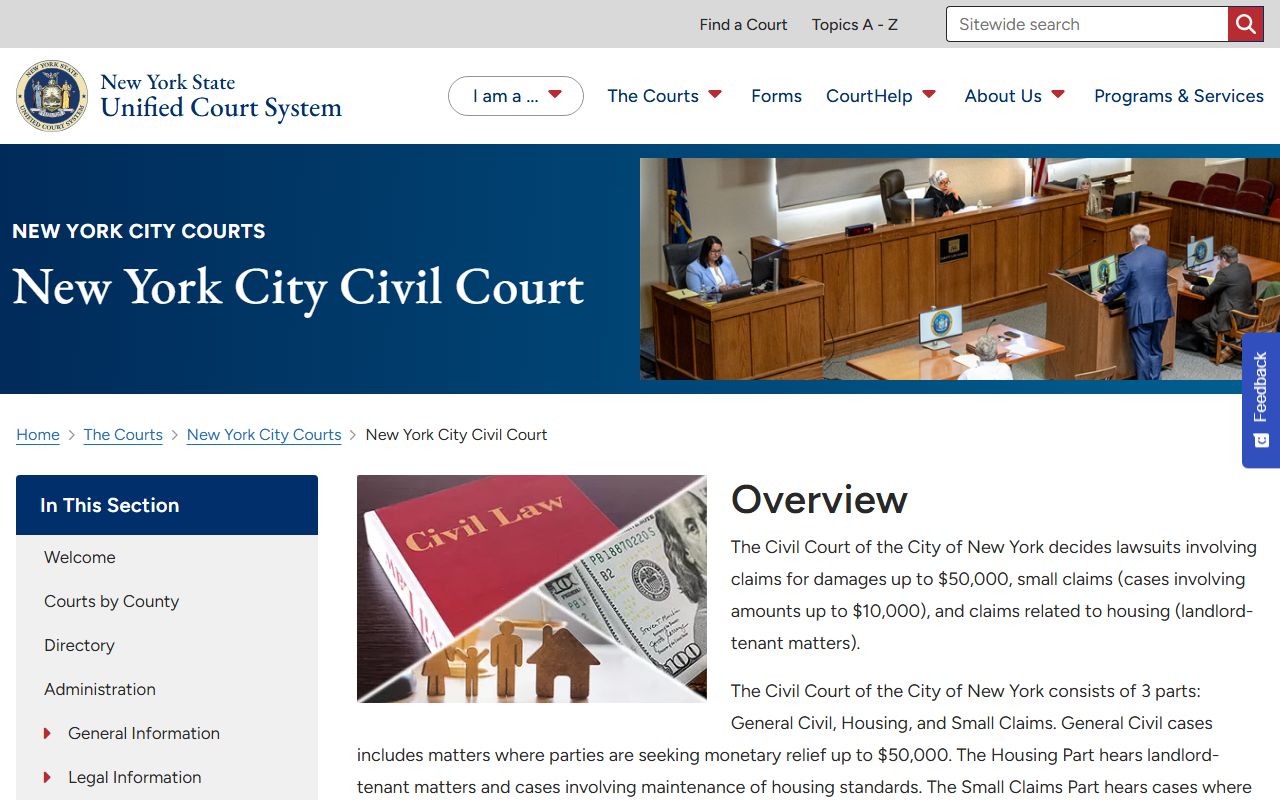
The page confirms that Civil Court General Civil jurisdiction covers monetary claims up to $50,000, that Housing Court handles landlord-tenant matters, and that Small Claims handles money disputes up to $10,000, all details that apply directly to the Richmond County branch where Staten Island residents file their cases.
Help Center, Legal Referral, and Self-Help Resources
The Richmond County Civil Court has a Help Center located on the ground floor. The Help Center phone is 718-675-8441. A virtual Civil and Small Claims Help Center is also listed at 646-386-5556 for remote assistance. Help Center staff can explain court procedures, provide forms, identify options, and offer general information, but they are not allowed to give legal advice or advocate for either side of a case. Their help is procedural, not strategic.
For legal representation when self-help is not enough, several options exist for Richmond County residents. Legal Services NYC at legalservicesnyc.org provides free civil legal services in housing, family, benefits, consumer, immigration, and other areas for income-qualified New Yorkers. LawHelpNY at lawhelpny.org is a statewide referral resource that matches users with local legal aid offices and self-help materials. The NYC Bar Legal Referral Service at nycbar.org provides paid-attorney referrals when a person does not qualify for legal aid but needs counsel.
The New York State Bar Association also operates a lawyer referral service. The NYSBA Lawyer Referral Service page describes the statewide program and how to connect with a lawyer in your practice area. Tenants in eviction cases may have access to free counsel under NYC's Right to Counsel program regardless of income, subject to building eligibility rules.
The image below is from the NYSBA Lawyer Referral Service, which connects Richmond County Civil Court litigants with attorneys when they need paid representation.

The NYSBA referral service covers the full range of civil legal matters that might bring someone to Richmond County Civil Court, including landlord-tenant disputes, small claims appeals, and consumer debt defense.