
Criminal Court vs Supreme Court Criminal Term in Richmond County
New York City Criminal Court, Richmond County branch, shares a building at 26 Central Avenue with Supreme Court. These are two separate courts with different jurisdictions. Criminal Court handles arraignments, misdemeanor prosecutions, violation cases, summons matters, and initial appearances for felony arrests. Its jurisdiction does not extend to trying felony indictments. Once a Richmond County grand jury hands up an indictment, the felony case transfers to Supreme Court Criminal Term, which has exclusive trial jurisdiction over felonies and may also take concurrent jurisdiction over misdemeanors where appropriate.
Many residents encounter this split without realizing it. A person arrested on a felony charge appears first in Criminal Court for arraignment, where bail or release conditions are set. The Richmond County District Attorney then screens the charge and, if a felony prosecution is sought, brings the matter before a grand jury. An indictment moves the case formally into Supreme Court Criminal Term at 26 Central Avenue, Room 240. From that point, all hearings, motions, the trial if there is one, and sentencing occur in Supreme Court, not in Criminal Court. Misdemeanors stay in Criminal Court from arraignment through disposition, and dismissals or acquittals trigger sealing under applicable statutes.
The comparison below shows the key differences between the two courts and what each handles.
| Feature | NYC Criminal Court, Richmond County | Supreme Court Criminal Term, Richmond County |
|---|---|---|
| Location | 26 Central Avenue, Staten Island, NY 10301 | 26 Central Avenue, Room 240, Staten Island, NY 10301 |
| Phone | 718-675-8700 | 718-675-8760 |
| Case types | Arraignments, misdemeanors, violations, summonses, preliminary felony appearances | Felony indictments, trials, sentencing, dispositions; concurrent misdemeanor jurisdiction |
| Felony role | Receives arrest; sets bail; forwards after indictment | Receives indicted case; all felony hearings and trial |
| Records search | WebCriminal: Richmond Criminal Court or Richmond Criminal Court - Summons | WebCriminal: Richmond Supreme Criminal Court |
| Appeals | Some appeals go to Appellate Term, 141 Livingston St., Brooklyn | Appeals go to Appellate Division, Second Department, 45 Monroe Place, Brooklyn |
The flow from arrest to disposition follows a set path. Knowing where the case sits determines which clerk to call and which WebCriminal dropdown to use when searching online.
How a Richmond County Criminal Case Moves Through the System
A felony arrest in Richmond County follows a defined sequence before it reaches trial or resolution. The steps below trace that path from the first court appearance through any appeal. Misdemeanor cases skip the grand jury stage and stay in Criminal Court through disposition.
The case flow: Arrest → Criminal Court Arraignment → Grand Jury Screening → Indictment → Supreme Court Criminal Term Arraignment → Pre-Trial Motions → Trial or Plea → Sentence → Appellate Division Second Department.
- Arrest and booking. Law enforcement arrests the person, processes booking, checks outstanding warrants, and photographs and fingerprints the individual. NYC DOC takes custody if bail is not posted or release conditions are not met at arraignment.
- Criminal Court arraignment. The first court appearance in NYC Criminal Court, Richmond County. The judge states the charges, addresses bail or release, and may issue or modify orders of protection. This appearance must occur promptly after arrest.
- Felony screening by the DA. The Richmond County District Attorney reviews the charge and decides whether to seek a felony indictment, reduce to a misdemeanor, or decline prosecution. The Criminal Court Division handles more than 10,000 cases each year.
- Grand jury proceedings. For felony matters, the DA presents evidence to a grand jury. Grand jury proceedings are secret by law. If the grand jury votes to indict, a formal indictment issues and the case moves to Supreme Court.
- Supreme Court Criminal Term arraignment. Once indicted, the case transfers to Room 240 at 26 Central Avenue. The defendant is arraigned on the indictment, bail is reviewed, and the case is assigned to a part and justice.
- Pre-trial motions and hearings. Suppression motions, discovery disputes, Wade hearings, and other pre-trial matters are heard in Supreme Court. Defense counsel and the DA exchange disclosure under New York discovery rules.
- Trial or plea disposition. The case resolves by guilty plea, trial verdict, or dismissal. Sentencing follows conviction and may include incarceration, probation, fines, restitution, and post-release supervision.
- Appeal. Appeals from Supreme Court Criminal Term go to the Appellate Division, Second Department. Further review goes to the New York Court of Appeals when the law permits.
Note: Misdemeanor cases that end favorably in Criminal Court, or that are dismissed or acquitted, may be sealed under CPL 160.50 after the case concludes.
How to Search Richmond County Criminal Cases Through WebCriminal
WebCriminal is the public tool for pending criminal cases with future court appearance dates in New York State. It covers Richmond County Criminal Court and Richmond Supreme Criminal Court. The search returns case information for active matters with future dates; it does not produce a complete criminal history, does not show sealed records, and does not function as a background check. Searches are free and no login is required.
The defendant search page at WebCriminal requires a name or corporation name. A notice on the page warns that WebCriminal may experience intermittent delays updating case information for a limited number of cases, and advises searching again later before concluding a case does not exist.
| Field Label | Type | Required | Notes / Format |
|---|---|---|---|
| First Name | Text | Required for person search | Enter at least the first two characters of the first name. |
| Last Name | Text | Required for person search | Enter at least the first two characters of the last name. |
| OR Corporation Name | Text | Required for entity search | Enter at least the first five characters of the corporation name in this field instead of the name fields. |
| Court | Dropdown | Optional | Choose All Courts, or narrow to Richmond Criminal Court, Richmond Criminal Court - Summons, or Richmond Supreme Criminal Court. |
| Display Results On this Page | Radio button | One output choice required | Results appear in the current browser window. |
| As a PDF Document | Radio button | One output choice required | Results download as a PDF file. |
Step-by-step instructions for a Richmond County criminal case search are below.
- Open WebCriminal Defendant Search from the NYS eCourts gateway or directly.
- Enter the first and last name. Use at least two characters of each. If searching a business, enter at least five characters of the corporation name in the corporation field and leave the name fields blank.
- Choose a court from the dropdown. For Richmond County misdemeanor and arraignment matters, select Richmond Criminal Court. For summons-only cases, select Richmond Criminal Court - Summons. For indicted felony matters in Supreme Court, select Richmond Supreme Criminal Court. Leave it on All Courts if you are not certain.
- Pick whether results appear on the page or as a PDF, then click Search.
- Review the listed cases. Click a case to view future appearance dates, the court, the part, and basic docket information.
- If the case is not found, check spelling, try a different court dropdown, or contact the Criminal Term clerk at 718-675-8760 directly.
What WebCriminal Does Not Show for Richmond County Cases
WebCriminal covers pending cases that have future appearance dates in the courts it includes. It is not a full criminal history database. A person's past dismissed cases, sealed records, youthful offender adjudications, or fully disposed cases from years ago will generally not appear. The system shows current status, not a complete history of all prior matters.
A complete statewide criminal history search requires a Criminal History Record Search, known as CHRS, through the court system. NY CourtHelp states that each CHRS search costs $95. That search is separate from WebCriminal and covers a broader record set, though it still does not include records sealed under Criminal Procedure Law and cannot substitute for official background checks done by law enforcement or licensing agencies.
- Sealed records after favorable termination are restricted from public view under CPL 160.50.
- Youthful offender adjudications are confidential and do not appear in public searches.
- Juvenile delinquency matters from Family Court are restricted by statute.
- Grand jury proceedings are secret by law while they are active.
- Disposed cases with no upcoming dates drop out of WebCriminal results.
- Courts not included in WebCriminal coverage will not appear at all.
For Richmond County arrest records and broader criminal history information, including what CHRS covers and how to get a certificate of disposition, see the arrest records page. For warrant-related searches, see warrant records.
The Richmond County District Attorney and Prosecution Bureaus
The Office of the District Attorney Richmond County is at 130 Stuyvesant Place in St. George, one block from the main courthouse. District Attorney Michael E. McMahon leads the office, with Ashleigh J. Owens as Chief Assistant District Attorney. The office's mission focuses on pursuing justice for crime victims, preventing crime, and promoting public safety on Staten Island. The Criminal Court Division alone processes more than 10,000 cases each year, according to the DA's official site.
Office of the District Attorney, Richmond County
130 Stuyvesant Place
Staten Island, NY 10301
718-876-6300
Email: info@rcda.nyc.gov
The DA office has a full roster of specialized bureaus and units, each handling a defined category of cases from Criminal Court intake through Supreme Court trial. Key bureaus are listed below with their direct lines.
| Bureau / Unit | Phone | Primary Focus |
|---|---|---|
| Criminal Court Division | 718-697-8340 | Misdemeanors, violations, summonses; 10,000+ cases per year |
| Trials Bureau | 718-697-8310 | Felony trials in Supreme Court Criminal Term |
| Domestic Violence Division | 718-697-8315 | Misdemeanor and felony DV; vertical prosecution since 2016 |
| Special Victims Bureau | 718-697-8313 | Sex offenses, child abuse; manages Mental Health Treatment Court |
| Narcotics & Investigations Bureau | 718-697-8319 | Drug offenses and related investigations |
| Appeals Bureau | 718-697-8317 | Post-conviction appeals and post-trial motions |
| Economic Crimes Bureau | 718-697-8318 | Financial fraud and white-collar crime |
| Juvenile Justice Unit | 718-697-8310 | Youth offenders; Youth Part coordination with Family Court |
| Alternatives to Incarceration Unit | 718-697-8310 | Diversion programs for eligible defendants |
| Victim Services Unit | 718-697-8333 | Victim support, court accompaniment, benefits referrals |
| Firearms Anti-Violence Unit | 718-697-8318 | Illegal weapons possession and firearms-related crimes |
| Vehicular Crimes Unit | 718-697-8310 | DWI felonies, vehicular assault, vehicular homicide |
Prosecutors from these bureaus appear in both Criminal Court and Supreme Court Criminal Term depending on the charge and case stage. The DA press archive lists recent indictments and case outcomes for matters of public interest.
Specialty Courts and Diversion Programs Available in Richmond County
Richmond County has several pathways that may divert eligible defendants from standard prosecution into court-supervised treatment or intervention. These programs are not automatic. A defendant must be screened by defense counsel, the DA, and often a treatment provider before a court approves diversion. Eligibility rules are not published as a simple checklist; anyone seeking entry should speak to defense counsel or the court directly.
Mental Health Treatment Court operates through the Special Victims Bureau of the DA's office, in collaboration with the Staten Island Advocacy Center. The pathway provides court oversight for defendants whose mental illness contributed to the charged conduct. Participants appear before a judge regularly, engage in treatment, and may see charges reduced or dismissed on completion, depending on the terms set by the court and the nature of the original charge. The court monitors progress and can revoke the arrangement if a participant fails to comply with treatment or reporting requirements.
The Alternatives to Incarceration Unit runs diversion programs for defendants dealing with substance use, mental health challenges, and other issues that contributed to the criminal conduct. The DA's site describes these programs as serving justice, improving participants' lives, and ensuring participants are no longer a threat to the community. ATI programs may involve drug treatment, counseling, community service, and regular check-ins with the court or probation. Completion does not guarantee dismissal; outcomes depend on the specific arrangement reached.
- Domestic Violence Bureau (established 2016): one ADA stays with a domestic violence case from arraignment through Supreme Court if the charge escalates. The bureau covers both misdemeanor and felony matters and supports victims through the process with direct contact and referrals.
- Youth Part and Juvenile Justice Unit: the Juvenile Justice Unit reviews charges involving individuals under 18 and coordinates with the NYC Law Department. Some youth matters are processed in the Youth Part of Family Court. Raise the Age legislation changed how New York treats certain teenage defendants in criminal proceedings.
- Vehicular Crimes Unit: handles DWI-related felonies, vehicular assault, vehicular homicide, and other serious traffic-related criminal matters that move from Criminal Court arraignment to Supreme Court Criminal Term. Traffic matters that are not criminal, such as DMV violations, are covered on the traffic court records page.
Access to any specialty court or diversion program is not guaranteed. Defendants with prior serious convictions, active warrants, or charges outside program eligibility may not qualify. Decisions rest with the presiding judge and, in many cases, the DA as well.
Sealing and Confidential Criminal Records in Richmond County
New York uses sealing rather than broad expungement. Sealing restricts public access but does not always destroy the file, and law enforcement, courts, prosecutors, and some licensing agencies may still access sealed records under statutory exceptions. The practical effect is that the public cannot search or view the record, but it has not been erased.
The main sealing paths under New York law are: CPL 160.50, which applies when a criminal action ends in the accused's favor such as dismissal or acquittal; CPL 160.55, which covers certain violation and traffic-infraction outcomes after conviction; and CPL 160.59, which allows a petition for sealing of certain older convictions after a statutory waiting period and a court review, subject to exclusions for serious offenses. The Clean Slate Act adds automatic sealing for some eligible old convictions on time frames set by statute, but implementation details and exclusions must be checked in current official guidance before relying on it.
To seal a record under CPL 160.59, a person typically files papers in the court of conviction, serves required parties including the DA, and waits for a hearing or administrative review. The DA may receive notice and object. The judge considers eligibility, the nature of the offense, the applicant's history, public safety, and rehabilitation before ruling. Common denial grounds include ineligible offense, too many prior convictions, pending charges, or an insufficient waiting period. Certificates of disposition are often needed as part of a sealing packet; get them before the record is sealed, because access to case details becomes harder afterward.
See the Richmond County arrest records page for more detail on sealed and confidential records, youthful offender rules, and how to request a certificate of disposition from the clerk.
Federal Criminal Cases and Richmond County Defendants
A Staten Island arrest can produce state charges in Criminal Court or Supreme Court, federal charges in the Eastern District of New York, or both in separate proceedings at the same time. Richmond County falls within the U.S. District Court for the Eastern District of New York. Federal criminal matters are handled by the U.S. Attorney's Office for the Eastern District of New York. Federal proceedings are completely separate from state criminal proceedings; a Richmond County grand jury indictment does not appear in EDNY records, and a federal indictment does not appear in WebCriminal.
Federal prosecutions in EDNY cover organized crime, financial fraud, public corruption, civil rights offenses, and narcotics trafficking, among many other areas. Cases begin at the federal district court and are searched through PACER, the federal case-access system, which charges per-page fees after free registration at pacer.uscourts.gov. The Richmond County Clerk cannot provide PACER filings; they are federal records and live in a separate system.
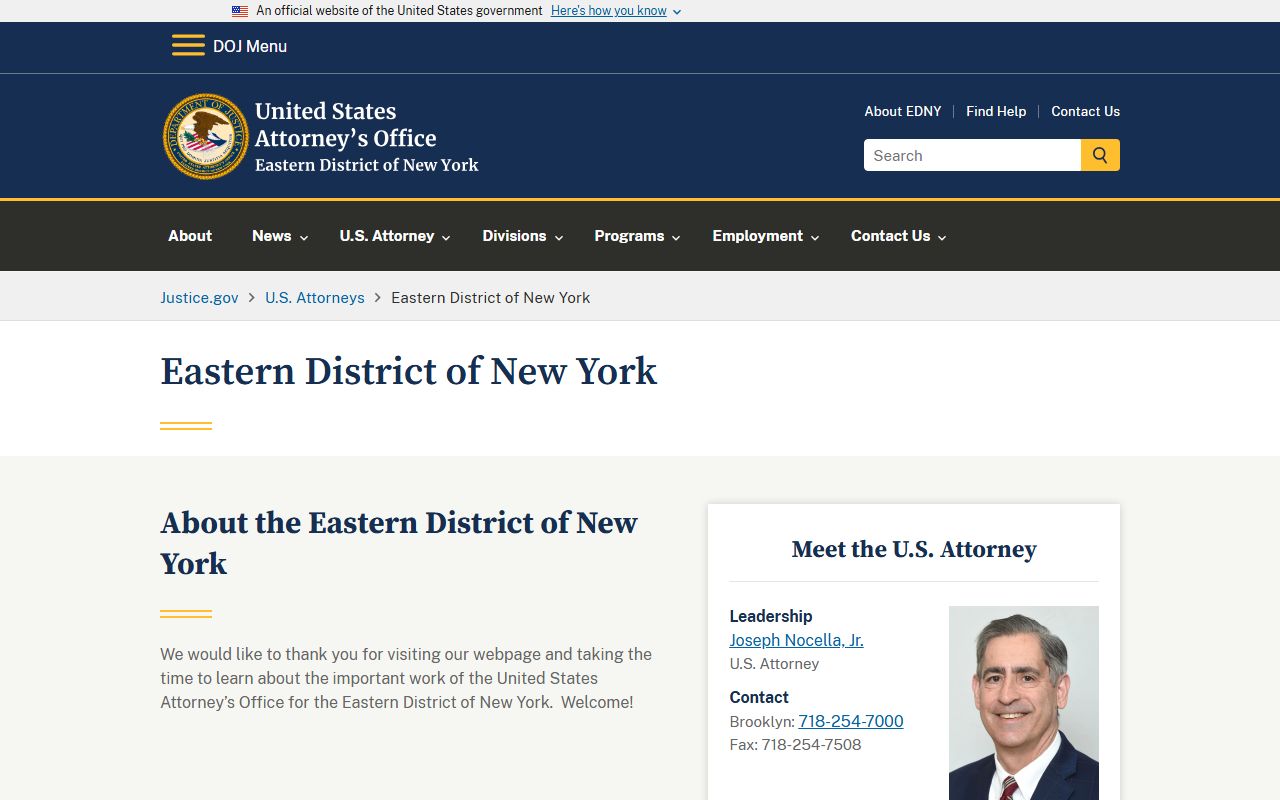
The image below is from the U.S. Attorney's Office for the Eastern District of New York, which handles federal prosecutions affecting Richmond County defendants alongside state proceedings.
Federal criminal appeals go to the U.S. Court of Appeals for the Second Circuit, a path distinct from the state Appellate Division, Second Department, which handles state criminal appeals from Richmond County Supreme Court. Federal prisoner transport and warrant service are handled by the U.S. Marshals Service, Eastern District of New York.
Richmond County Criminal Court Appeals to the Second Department and Appellate Term
Where a Richmond County criminal case appeals depends on which court issued the final judgment. Criminal Court appeals, including misdemeanor and violation convictions, may route to the Appellate Term for the Second Judicial Department before reaching the Appellate Division. The Appellate Term sits at 141 Livingston Street, 15th Floor, Brooklyn, with phone 347-401-9580 listed in the Civil Court directory.
Felony convictions from Supreme Court Criminal Term appeal directly to the Appellate Division, Second Department, at 45 Monroe Place, Brooklyn, NY 11201. Further review, when the law permits, goes to the New York Court of Appeals, the state's highest court. Strict deadlines apply to notices of appeal. Missing a deadline can forfeit the right entirely, so anyone seeking to appeal a criminal conviction should speak to defense counsel without delay.
For more on Richmond County Supreme Court operations, including Civil Term matters and the clerk structure, see the Richmond County Supreme Court page.