
What Richmond County Family Court Handles
Family Court in New York is a specialized statewide trial court. It does not handle divorce. Divorce belongs to Supreme Court. What Family Court does handle is the range of legal matters that arise within and around families, particularly when children or protection are involved. For Staten Island residents, Richmond County Family Court is at 18 Richmond Terrace in the St. George courthouse area.
Custody and visitation cases are filed here when parents are not married or when custody is contested outside a divorce. Child support petitions, modification requests, and enforcement proceedings run through Family Court. A parent who has not received support payments, or who needs to modify an existing support order, files in Family Court. The court issues and enforces support orders and can refer matters to a support magistrate for hearings.
Family offense petitions and orders of protection are filed in Family Court when the parties have a family or intimate relationship. These include cases between spouses, former spouses, people who share a child, household members, and people in intimate relationships. Family Court can issue a temporary order of protection and, after a hearing or adjudication, a final order. Criminal orders of protection may also exist through Criminal Court or Supreme Court Criminal Term, so a single situation can produce proceedings in more than one court.
Child abuse and neglect proceedings, juvenile delinquency cases for youth under 16, foster care approval and review, guardianship petitions for minors, and adoption-related matters are all within Family Court jurisdiction. The court also handles Persons in Need of Supervision cases and, through coordination with the District Attorney, youth criminal matters under the Raise the Age law.
Richmond County Family Court Address and Access
Family Court is at 18 Richmond Terrace, in the same St. George civic center area as the Surrogate's Court. The courthouse serves the entire borough of Staten Island. All visitors pass through a magnetometer before entering. Bring only what you need; oversized bags slow the process. ADA access is available, with a ramp at the back/main-ramp entrance and accessible bathrooms on the first and second floors. For disability accommodations, contact the court ahead of your visit.
Richmond County Family Court
18 Richmond Terrace
Staten Island, NY 10301
718-675-8800
Court Hours: Mon-Fri, 9 a.m. to 5 p.m.
Doors Open: 8:30 a.m.
Petitions accepted from: 8:30 a.m.
Children's Center: 1st Floor, 9 a.m.-1 p.m.
On-site Spanish interpreters are available. Other languages can be arranged through the court's interpreter services; contact the clerk ahead of time to request a specific language. The Children's Center is on the first floor and is open 9 a.m. to 1 p.m. for families attending court with young children.
By transit, take the Staten Island Railway or any city bus to St. George Terminal, then walk toward Richmond Terrace. By car from the Staten Island Expressway, take the Bay Street/Lily Pond Road exit, turn left at the light, follow to the end, turn left onto Bay Street, continue to the St. George Ferry Terminal, turn left onto Richmond Terrace, and continue two blocks. Municipal parking is available on Hyatt Street. Confirm rates before arrival; court days in St. George can be busy.
WebFamily Search for Richmond County Family Court Cases
WebFamily is the New York State public case search system for Family Court. It is free and does not require a login. The system covers active Family Court and Integrated Domestic Violence cases with future court appearances. That is an important limitation: WebFamily does not show the full file, does not show confidential details, and does not show closed or disposed cases without upcoming dates.
The WebFamily search portal gives three search modes, as shown in the table below.
| Search Mode | Type | How It Works |
|---|---|---|
| File/Docket Search | File Number or Case Docket Number | Enter the specific file number or docket number for the case you are searching. |
| Attorney/Firm Search | Attorney or firm name | Search by the name of an attorney or law firm to find associated active cases. |
| Calendar | County, court location, date, and judge/part | Generate a court calendar by selecting county, location, date range, and assigned judge or part. |
WebFamily does not support party-name searches the same way WebCivil does. If you do not have a file number, the calendar search may be the most useful starting point. Narrow by Richmond County, the Family Court at 18 Richmond Terrace, a date range around the expected court date, and a judge or part if known.
The WebFamily case search portal shows the available search modes and the scope of case types covered, including Family Court and IDV matters with upcoming appearances.
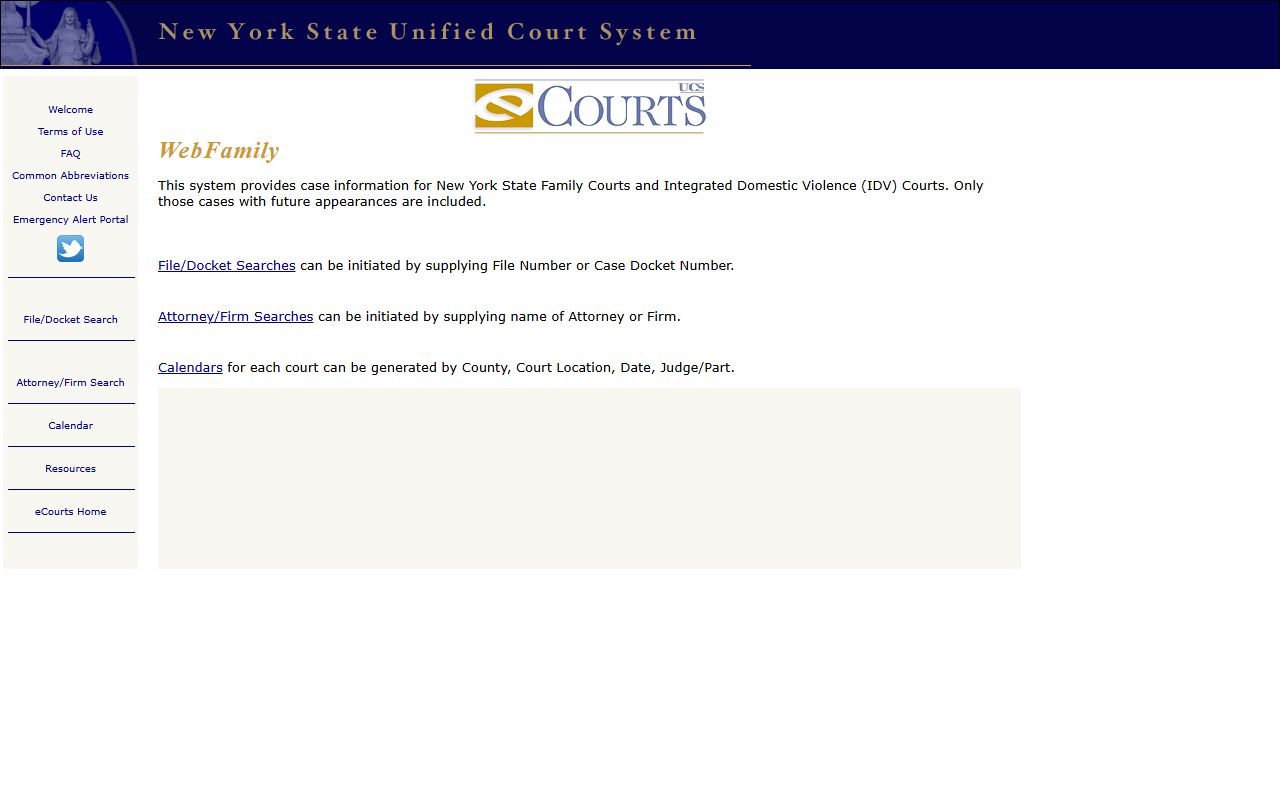
This view of the WebFamily portal shows the three search modes and the coverage notice confirming that results are limited to active cases with future appearances, reflecting the confidentiality rules that govern Family Court records.
Why Most Richmond County Family Court Records Are Confidential
Important: Family Court Act Section 166 restricts public access to most Family Court proceedings and records. Cases involving children, abuse and neglect, juvenile delinquency, adoption, and family offense matters are not open to the general public. Attendance at hearings is generally limited to parties, their attorneys, and authorized persons. Online searches through WebFamily show only active cases with future appearances and do not reveal confidential case details.
The confidentiality rule is not a technical limitation of WebFamily. It is a statutory and policy choice. Family Court Act Section 166 and related rules restrict who may attend proceedings and who may access the files. The reasoning is straightforward: cases involving minor children, abuse allegations, mental health, and intimate family matters carry strong privacy interests that outweigh the general public interest in open records.
Custody files, abuse and neglect reports, juvenile delinquency records, foster care documents, and adoption-related materials are all restricted to parties, counsel, authorized agencies, and persons granted access by court order. A member of the public who wants to know the outcome of a custody dispute involving private parties will generally not get that from any public search tool. Even a party to a case must usually appear in person or through counsel to access the full file.
Attorneys who represent clients in Family Court can access their client's files directly. Social services agencies, the Administration for Children's Services, law guardians, and other authorized participants have defined access rights under statute and rule. For everyone else, a formal application or court order is typically required to see restricted Family Court materials.
Custody and Support Records in Richmond County Family Court
Custody and visitation orders come from Family Court when parents are not married, and from Supreme Court when they are issued as part of a divorce. The two orders can coexist for the same family, and modifying one may require going back to whichever court issued it. Family Court handles initial custody filings for unmarried parents, petitions to modify existing orders, violation petitions when a parent is not following an order, and relocation disputes where a parent wants to move with a child.
Child support in Richmond County runs through Family Court and, for certain cases, through Supreme Court. Family Court has support magistrates who hold hearings on support petitions, modifications, and enforcement matters. Support orders can be enforced through income execution, license suspension, and other remedies. The Support Collection Unit, operated by the city, handles collections for cases where an order is in effect and support is owed.
The details of a custody or support case are not public. The case file, the hearing transcript, financial affidavits, home studies, and child interviews are all restricted. If a party needs a copy of their own order, they request it through the Family Court clerk. Courts can provide certified copies of orders to parties upon request and payment of any applicable copy fee. Third parties generally cannot obtain these records without authorization.
Family Offense and Orders of Protection in Richmond County
A family offense petition is how a person seeks protection in Family Court. The petitioner claims that a family or household member has committed one or more family offenses, which are defined acts such as assault, harassment, menacing, stalking, or sexual offenses. Family Court can issue a temporary order of protection right away and then schedule a hearing to determine whether a final order is warranted.
Orders of protection from Family Court differ from criminal orders of protection, which come from Criminal Court or Supreme Court Criminal Term. A single incident of domestic violence can produce both a Family Court petition and a criminal case, resulting in overlapping protection orders from two different courts. If the offenses are also being prosecuted criminally, the Richmond County District Attorney's Domestic Violence Division handles the criminal side. That division was created specifically to vertically prosecute domestic violence cases, keeping them with one prosecutor from start to finish. For details on the criminal side, see the Richmond County Criminal Court page.
Family offense proceedings are restricted. The hearing is not open to the public, and the records are not accessible through public search tools. Victims who have an existing order can contact the Family Court clerk about enforcement, violations, and modifications. Law enforcement has access to order-of-protection records through official channels regardless of whether the file is publicly visible.
Youth Part and Raise the Age Coordination in Richmond County
New York's Raise the Age legislation raised the age of criminal responsibility so that 16- and 17-year-olds charged with crimes are generally handled in the Youth Part of Family Court rather than adult criminal courts. Some serious offenses can be removed to adult court, but the default for eligible youth is a Family Court proceeding with a focus on youth-appropriate outcomes.
The Richmond County District Attorney's Juvenile Justice Unit reviews crimes by individuals under 18. The unit decides whether the office may prosecute in Criminal Court and works with the NYC Law Department to coordinate processing in the Youth Part of Family Court. That coordination means a youth offense can move between court systems depending on the charge, the person's history, and the outcome of removal proceedings.
Youth Part records are subject to additional confidentiality protections beyond the general Family Court Act restrictions. Youthful offender adjudications are sealed and are not visible in public court records searches. Records that would identify a youth in a delinquency proceeding are restricted. Parents and guardians of youth in proceedings have defined rights to access their child's records; others do not.
The DA's Alternatives to Incarceration Unit offers diversion programs for eligible youth and adults who are struggling with substance use or mental health issues connected to their criminal behavior. Eligibility is determined case by case. Neither the court nor the DA's office publishes a simple checklist of who qualifies; individuals interested in diversion should ask their attorney or court-appointed counsel at arraignment.
Help and Self-Represented Resources for Richmond County Family Court
Richmond County Family Court does not have a standalone Help Center in the way Surrogate's Court does, but resources exist for people who do not have an attorney. NY CourtHelp covers Family Court topics including custody, support, guardianship, family offense, and juvenile matters with plain-language explanations and links to official forms. The NY courts forms library at forms.nycourts.gov includes all required Family Court petition forms.
Self-represented litigants in Family Court face real challenges. These cases can move quickly, involve children, and carry consequences that affect custody and parental rights for years. Court staff can explain procedure and direct you to the right forms, but they cannot give legal advice or help you build your case. If you qualify financially, legal aid may be available.
- LawHelpNY: statewide civil legal aid matching and self-help information covering Family Court topics.
- Legal Services NYC: civil legal services for qualifying city residents, including family and housing matters.
- NYC Bar Legal Referral Service: connects people to paid attorneys when free help is not available.
- NYSBA Lawyer Referral Service: statewide attorney referral service.
For matters related to probate, estate, or guardianship of an adult, see the Richmond County Surrogate's Court page. For the criminal side of domestic violence or related criminal cases, see the Criminal Court page. The main court records page covers the full eCourts portal and how to choose the right search tool for each case type. For marriage and divorce questions, see the marriage and divorce records page.