
NYC City Clerk Marriage Licenses for Staten Island
Marriage licenses in Staten Island are not issued by any court. They come from the New York City Clerk, which runs the Marriage Bureau for all five boroughs. The Richmond County Clerk, the Surrogate's Court, and the Supreme Court do not issue marriage licenses. If you show up at a courthouse asking for a marriage license, staff will direct you to the City Clerk.
The NYC City Clerk marriage license page is the official starting point. It explains the appointment system, required identification, and the application process. The City Clerk's office is open for in-person appointments only. No walk-ins are accepted. Do not go to a Marriage Bureau location unless you have a scheduled appointment and a confirmation email in hand.
Marriage license records for more recent marriages are held by the City Clerk. The City Clerk marriage records page describes how to obtain a copy of a marriage record. For historical marriages, especially those from earlier decades, records may be held by the NYC Department of Records and Municipal Archives rather than the current City Clerk office.
The NYC City Clerk marriage license portal shows the Project Cupid appointment system and lists all requirements for applying for a marriage license in Richmond County.
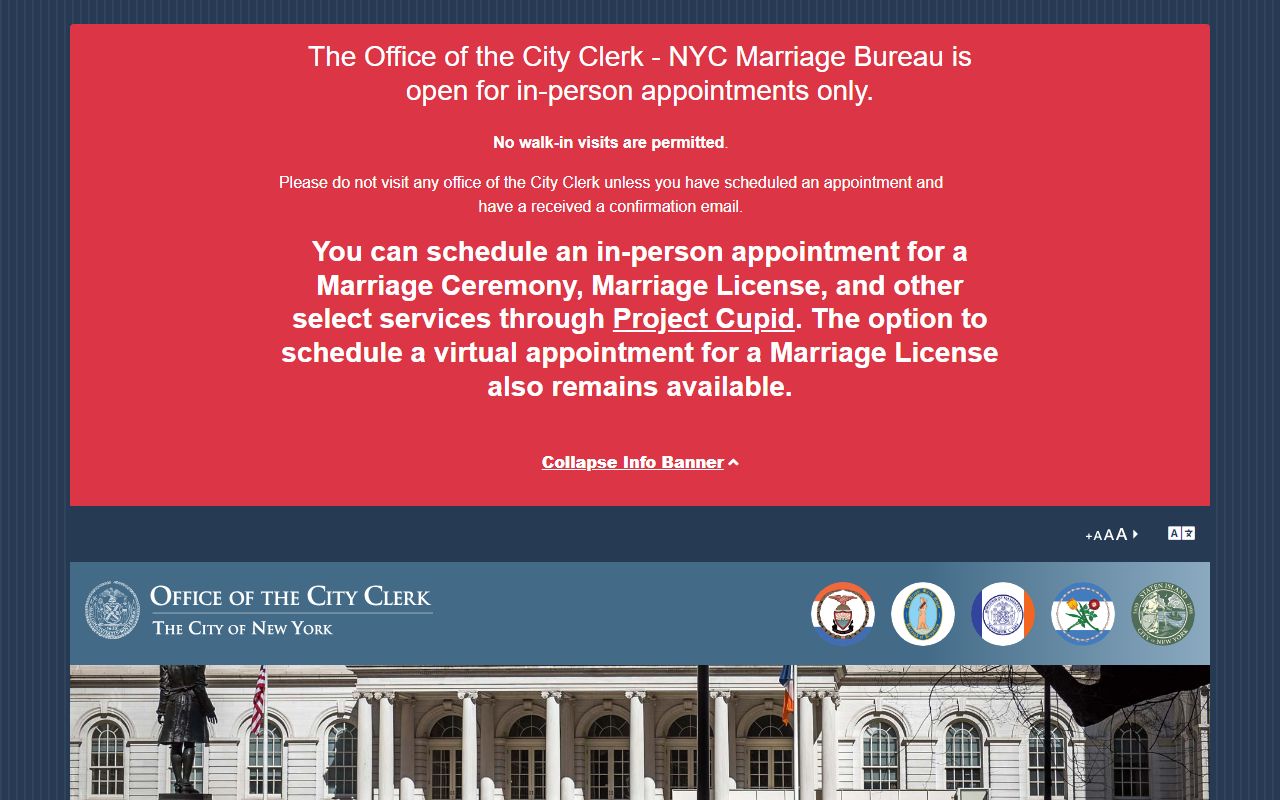
This City Clerk page shows the current appointment-only rules and the Project Cupid system, including the virtual appointment option for marriage license applications.
Project Cupid Appointments and Richmond County Marriage Applications
Project Cupid is the NYC City Clerk's online system for marriage license appointments, marriage ceremony appointments, and other select Marriage Bureau services. Both applicants must be involved in the application. The system requires a NYC.ID account or equivalent login, and the application is completed online before the appointment. No walk-in visits are allowed; the City Clerk's page states explicitly that users should not visit a Marriage Bureau location without a confirmation email for a scheduled appointment.
A virtual appointment option remains available for marriage license applications. This can be useful for applicants who cannot travel to an in-person location on a specific date. The virtual option does not cover marriage ceremonies, which require in-person attendance with the officiant. Check the current City Clerk page for which services are available virtually at the time you apply, because options can change.
The marriage license application form fields captured from the Project Cupid system reflect the information both applicants must supply. The full downstream fields are behind the NYC account and appointment workflow, so the table below reflects the major categories.
| Form Section | Type | Required | Notes |
|---|---|---|---|
| Applicant information | Web form fields | Yes | Full name, date of birth, address, prior marriages for each applicant. |
| Account / login | NYC.ID / Project Cupid login | Yes | Both applicants may need to participate in the account and application flow. |
| Appointment selection | Calendar/booking | Yes | Choose in-person or virtual; pick date, time, and location. |
| Identification documents | Upload or present at appointment | Yes | Government-issued photo ID required; verify current ID list on City Clerk page. |
The city marriage license fee is listed in many NYC sources. Verify the current amount on the City Clerk page before your appointment, as fees can change. A marriage license is valid for a limited time after issuance; the ceremony must occur within the validity window. After the ceremony, the officiant returns the completed license for recording.
How to Apply for a Richmond County Marriage License
Both people getting married must be part of the application. The process runs through Project Cupid, not through any Richmond County court or clerk's office. Follow these steps to apply.
- Go to the NYC City Clerk marriage license page and read the current requirements for identification, fees, and prior marriages.
- Create or log in to a NYC.ID or Project Cupid account. Both applicants should be ready to provide their information through the system.
- Complete the application with full legal names, dates of birth, current addresses, and prior marriage history for each applicant.
- Select an appointment type (in-person or virtual) and choose a date and time. Confirm that you receive a confirmation email before going anywhere in person.
- Attend the appointment with required government-issued photo ID and any supporting documents listed on the City Clerk page. Do not arrive without a confirmed appointment.
- Pay the city marriage license fee at the time of the appointment.
- Receive the license after the appointment is completed. The license has a validity period; schedule the ceremony within that window.
- Have the ceremony performed by an authorized officiant, who then returns the completed and signed license for recording with the City Clerk.
- Request a marriage record or certificate copy through the City Clerk's marriage records process after recording is complete.
For historical marriage records from earlier decades, contact the NYC Department of Records and Municipal Archives, which holds older city vital records including birth, death, and marriage records.
Marriage Records and Historical Archives for Richmond County
The NYC City Clerk holds modern marriage records. For older records, the NYC Department of Records and Municipal Archives is the official historical repository. The Archives holds vital records from earlier periods of New York City history, including marriages that predate current City Clerk systems. If you are searching for a marriage that occurred decades ago, the Archives may have the record even if the City Clerk does not.
The Richmond County Clerk fee schedule includes "Authentication of Certificate of Marriage" at $3. This is a separate service from obtaining the underlying record. Authentication by the County Clerk is used when a certified record needs an additional official stamp or validation, not when you are requesting the original certificate for the first time. Go to the City Clerk for the original; go to the County Clerk only if you already have the record and need authentication for a foreign or other legal use.
Researchers doing genealogical work may find that both sources are useful at different time periods. The NYC Department of Records catalog and the City Clerk records page together cover much of the recorded marriage history for Staten Island residents. For very old records, microfilm or older paper formats may be the only option.
Supreme Court Divorce Venue in Richmond County
Divorce in New York is a Supreme Court matter. The state's courts website says Supreme Court is the only court in New York that grants a divorce. Richmond County Supreme Court, at 26 Central Avenue, Staten Island, NY 10301, is where divorce actions are filed and decided for Staten Island residents. Family Court does not grant divorces, even if it handles related custody and support matters for the same family.
Filings go through the County Clerk's office, which collects fees and maintains the file as the Supreme Court records officer. The index number, which starts the case and assigns it a docket, costs $210 and is purchased through the County Clerk. Electronic filing through NYSCEF may be available for Richmond County matrimonial matters; check the current e-filing rules or the Richmond County Supreme Court page for details on mandatory e-filing expansion.
Domestic Relations Law Section 235 restricts public access to matrimonial papers. A divorce case may appear in a WebCivil Supreme search, but the pleadings, affidavits, financial disclosures, and other documents are not freely open to the public the way ordinary civil case files are. Parties, their attorneys, and persons with court authorization may obtain documents through the clerk; others may need a court order or a formal application to access specific records.
For more about what Supreme Court handles and how civil and matrimonial filings work in Richmond County, see the Richmond County Supreme Court page.
Uncontested Divorce Filing Fees in Richmond County
The NY Courts uncontested divorce page states that an uncontested divorce costs at least $335 in court filing fees. The index number alone is $210. That is the base cost before accounting for other required filings, service costs, and potential motion fees. Below is a fee schedule drawn from the official Richmond County Clerk fee page.
| Item | Amount |
|---|---|
| Index number (starts the case) | $210 |
| Uncontested divorce minimum total filing fees | $335 |
| Settlement agreement filing fee | $35 |
| Note of Issue for Uncontested Matrimonial (includes RJI) | $125 |
| Stipulation or voluntary discontinuance | $35 |
| Certified copy of a court record | $8 per document plus $0.25 per page |
| Plain copy, per page | $0.25 |
| In forma pauperis motion (fee waiver) | No fee |
Fee waivers are available for people with extreme financial hardship. Ask the clerk for the fee-waiver form before paying, not after. Once a fee is paid, it generally is not refunded if the case is later discontinued.
The Richmond County Clerk fee page is the authoritative source for current filing fees. Always verify before filing because fees can change.
Required Divorce Forms for Richmond County Supreme Court
The NY Courts uncontested divorce page lists the initial required papers for an uncontested divorce. Every Richmond County divorce begins with this set of documents, and additional forms may be required depending on whether children are involved, whether there is a settlement agreement, and other case-specific factors.
- Summons with Notice or Summons and Complaint, depending on the divorce type and whether the complaint is included in the initial filing.
- Notice of Automatic Orders, which takes effect when the divorce action is filed and restricts both parties from certain financial and property actions.
- Notice Concerning Continuation of Health Care Coverage, which informs both parties of their rights and responsibilities regarding health insurance during and after the divorce.
- Settlement Agreement, if the parties have reached a written agreement on property, support, and other matters; the filing fee for this document is $35.
The full uncontested divorce packet is available through the NY Courts uncontested divorce forms page and the general NY courts forms library. The packet includes instructions, checklists, and all required forms for both the no-children and children-under-21 variations of the uncontested process. Read the instructions fully before completing any form, because errors in a divorce packet can delay the case.
Note: If you have children under 21, the uncontested divorce packet is different from the no-children version. Use the right one from the start or the case may need to be corrected or refiled.Serving the Defendant in a Richmond County Divorce Action
After filing the initial papers, the plaintiff must serve the defendant. New York law does not allow the plaintiff to serve the defendant personally. Service must be completed by a person who is not a party to the action, is at least 18 years old, and follows the service rules under the Civil Practice Law and Rules. A process server or a trusted adult can handle service, but the plaintiff cannot.
After service, proof of service must be filed with the court. This is usually an affidavit of service signed by the person who completed service. Timing matters: there are deadlines for completing service after filing, and failing to serve within the allowed time can result in dismissal of the action. Check the instructions in the divorce packet for current service deadlines and acceptable methods.
If the defendant cannot be located or is avoiding service, alternative service methods such as service by publication may be available, but those require a court order and additional steps. The NY Courts uncontested divorce page covers service requirements in plain language. For contested divorces, or for cases where service is complicated, consult an attorney before proceeding.
Confidential Richmond County Divorce Records
Divorce records in Richmond County are not treated as open public records like ordinary civil case files. Domestic Relations Law Section 235 governs inspection of papers in matrimonial actions. Pleadings, affidavits, findings of fact, conclusions of law, and other documents in a divorce case are restricted from general public inspection. This rule exists to protect financial disclosures, family information, and personal details that divorce cases typically contain.
The case itself may appear in WebCivil Supreme if you search by index number or party name. A case shell showing the index number, filing date, parties, and status is sometimes visible. But seeing a case in the search results does not mean you can pull and read every document. The full file, including financial affidavits and settlement agreements, is restricted. Parties and their attorneys can access their own file. Third parties generally need authorization or a court order.
Certified copies of a divorce judgment or decree are available through the Richmond County Clerk at $8 per document plus $0.25 per page for court records. But access to the underlying papers, not just the judgment, may require a formal application. If you need a certified copy of a divorce judgment for a specific legal purpose such as remarriage, a name change, or a benefits claim, contact the County Clerk with the index number and parties' names.
For related records, see Surrogate's Court for estate matters that arise after a spouse's death, Richmond County Clerk for certified copies and court filing fees, and public records for the broader framework of New York record access laws.