
New York Supreme Court Is Not the Highest Court
Most states use "Supreme Court" for their top appellate court. New York does not. Here, the Supreme Court is the statewide court of general original jurisdiction, meaning it is the main trial court where most serious civil and criminal matters begin and are decided. The highest court in New York is the Court of Appeals, which sits in Albany and hears only selected appeals.
In Richmond County, Supreme Court sits at 26 Central Avenue in St. George. It hears civil cases beyond Civil Court's dollar limits, matrimonial actions such as divorce and separation, foreclosures, Article 78 proceedings, and felony criminal prosecutions through its Criminal Term. The court is part of the 13th Judicial District. Administrative Judge Hon. Raymond L. Rodriguez oversees operations; Chief Clerk Kenneth Fay runs the court's operational offices.
Appeals from Richmond County Supreme Court go to the Appellate Division, Second Department, in Brooklyn. Further review by the Court of Appeals is available only when the law permits it, not as a matter of right in most cases. This three-level path, trial court to Second Department to Court of Appeals, is the standard New York state route for litigants appealing a Richmond County Supreme Court decision.
Note: Users searching for the "New York Supreme Court" expecting a top appellate court are looking for the Court of Appeals, which is a separate institution with a different website and a different role.
Richmond County Supreme Court Address and Building
The courthouse is in St. George, the civic and government center of Staten Island, a short walk from the Richmond County Clerk's office, Borough Hall, the Surrogate's Court, Family Court, and the Staten Island Ferry terminal. The main entrance requires magnetometer screening; visitors should avoid bringing prohibited items and allow extra time for security lines on busy court days.
Richmond County Supreme Court
26 Central Avenue
Staten Island, NY 10301
718-675-8700
Criminal Term, Room 240: 718-675-8760
Email: RichmondSupreme@nycourts.gov
Transit to the courthouse is straightforward. The Staten Island Railway and city bus routes all serve St. George Terminal; from there, walk uphill toward Central Avenue and Stuyvesant Place. By car from the Staten Island Expressway, take the Bay Street/Lily Pond Road exit, turn left at the light, follow to the end, turn left onto Bay Street, continue to the St. George Ferry Terminal, then turn left onto Richmond Terrace and continue into the courthouse area. Paid public parking garages are nearby; confirm rates before arrival because courthouse pages do not publish guaranteed garage prices.
The court's administration team is listed on the official NY Courts page. Hon. Raymond L. Rodriguez serves as Administrative Judge. Kenneth Fay is Chief Clerk. Anthony Karakosta is Clerk of Operations. John Tenaglia heads the Civil Term, and Siobhan H. Shea-Gillespie leads the Criminal Term.
Richmond County Supreme Court Terms and Divisions
Supreme Court operates two primary terms in Richmond County, each handling distinct case categories. The table below shows the court's structure drawn from the official 13th Judicial District departments page and the Supreme Court contact information.
| Court / Term | Role | Address | Phone |
|---|---|---|---|
| Supreme Court, Civil Term | General civil jurisdiction, matrimonial/divorce, foreclosures, higher-dollar civil actions, Article 78 proceedings, e-filed civil cases | 26 Central Avenue, Staten Island, NY 10301 | 718-675-8700 |
| Supreme Court, Criminal Term | Felony prosecutions; concurrent misdemeanor jurisdiction; arraignment through disposition; appeals on dispositions to Second Department | 26 Central Avenue, Room 240, Staten Island, NY 10301 | 718-675-8760 |
Both terms share the same courthouse and phone main line, but they have separate clerks and separate filing procedures. A civil case goes to John Tenaglia's Civil Term office; a felony matter runs through Siobhan H. Shea-Gillespie's Criminal Term office in Room 240.
Richmond County Supreme Court Civil Term
The Civil Term handles the broadest range of cases. If a civil lawsuit asks for money or relief beyond Civil Court's $50,000 limit, it belongs in Supreme Court. Divorce, separation, and annulment actions are also Supreme Court matters because New York Supreme Court is the only court that grants divorces in the state. Foreclosures, commercial contract disputes, Article 78 proceedings challenging government decisions, and other equitable matters all come through Civil Term.
E-filing of Supreme Court civil cases runs through NYSCEF. Since the 2025 mandatory expansion, more civil case types must be filed electronically through that system. Court documents that have been e-filed can be read online through NYSCEF's guest search without creating an account. Paper case files for older matters may require a request to the Richmond County Clerk, since the County Clerk acts as the clerk of record for Supreme Court civil files and holds the physical record. The Richmond County Clerk page covers how to request those copies and what fees apply.
The Civil Term also handles the filing of the Request for Judicial Intervention, or RJI, which triggers judicial assignment in civil cases. Filing an RJI is a key step in moving a civil case forward after the index number is purchased. Without an RJI, a case can sit on the docket without a judge actively managing it.
Criminal Term: Richmond County Felony Prosecutions
Felony charges in Richmond County are prosecuted in Supreme Court Criminal Term. Cases usually begin with an arrest and arraignment in New York City Criminal Court, where the person faces the initial charges, bail is set or release conditions are determined, and the case gets a court date. Misdemeanors stay in Criminal Court. Felonies are reviewed by the Richmond County District Attorney's office and, if a grand jury issues an indictment, the case moves to Supreme Court Criminal Term for trial, motions, pleas, and sentencing.
The Richmond County DA's Criminal Court Division processes more than 10,000 cases each year, according to the official DA site. Felony screening happens early; each case goes to the bureau or unit that matches the charge type, whether the Trials Bureau, Narcotics Bureau, Domestic Violence Division, Special Victims Bureau, or another unit. Cases that result in a guilty plea or trial verdict in Supreme Court Criminal Term can then be appealed to the Appellate Division, Second Department.
The Richmond County Criminal Court page explains the earlier stages of the criminal process, including arraignment, misdemeanor prosecution, and bench warrants. For a felony case that has moved through indictment into Supreme Court, the Criminal Term clerk in Room 240 is the right contact.
Supreme Court vs. Civil Court vs. Criminal Court
Users often confuse Richmond County's courts because the names overlap in everyday language. The comparison below sets out what each court handles so you can identify where a specific record lives.
| Court | What It Handles | Dollar or Charge Limit |
|---|---|---|
| Supreme Court, Civil Term | Major civil disputes, divorce, foreclosures, Article 78 proceedings | No ceiling; handles cases above Civil Court's $50,000 cap |
| Supreme Court, Criminal Term | Felony prosecutions from indictment through sentencing | Felony charges; concurrent misdemeanor jurisdiction |
| NYC Civil Court, Richmond Branch | Consumer debt, landlord-tenant, small claims, housing | General Civil up to $50,000; Small Claims up to $10,000 |
| NYC Criminal Court, Richmond | Arraignments, misdemeanors, violations, summonses, preliminary felony proceedings | Misdemeanors and below; felonies leave after indictment |
A single dispute can touch more than one court. A landlord-tenant fight over money under $50,000 stays in Civil Court, but an eviction that also involves a felony assault by one of the parties would send the criminal charge to Criminal Court and eventually Supreme Court Criminal Term. The court records live in separate systems and separate clerk offices. See the Richmond County court records page for the full breakdown of which tool to use for each court type.
Matrimonial and Divorce Cases in Richmond County Supreme Court
Divorce is a Supreme Court matter in New York. No other court can grant one. The case is filed with the Richmond County Clerk, which serves as the clerk of record for Supreme Court matters, and the filing begins when the plaintiff buys an index number for $210. An uncontested divorce costs at least $335 in total filing fees, and additional fees apply depending on whether children are involved, a settlement agreement is filed, and other case-specific factors.
Matrimonial files are not as open as ordinary civil cases. Domestic Relations Law Section 235 restricts public inspection of matrimonial pleadings and affidavits. A case number may appear in a court search tool, but the documents themselves may not be open to people who are not parties or their attorneys. If you need a copy of a divorce decree, contact the Richmond County Clerk or the Supreme Court Civil Term clerk and be ready to explain your relationship to the case.
The Richmond County marriage and divorce records page covers the full divorce filing workflow, marriage license procedures through the NYC City Clerk, and how to access marriage records. Matrimonial cases filed through NYSCEF may also have some documents available through NYSCEF guest search, subject to confidentiality restrictions.
How to Search Richmond County Supreme Court Records
Supreme Court civil cases are searched through WebCivil Supreme, the statewide public portal for Supreme Court civil matters. It covers past, present, and future case information. For e-filed cases, NYSCEF guest search shows documents filed electronically. For pending criminal cases with future court dates, WebCriminal searches by defendant name and narrows to Richmond Supreme Criminal Court.
The NY Courts page on getting court records explains eCourts, clerk requests, and the NYSCEF guest search path. Use these official starting points before contacting the clerk to confirm a case is actually unavailable online.
- Identify whether the case is civil or criminal. Civil cases use WebCivil Supreme; criminal cases use WebCriminal; e-filed civil documents use NYSCEF guest search.
- Open the correct portal. WebCivil Supreme is at iapps.courts.state.ny.us/webcivil/FCASMain. NYSCEF is at iapps.courts.state.ny.us/nyscef/HomePage. WebCriminal is at iapps.courts.state.ny.us/webcrim_attorney/DefendantSearch.
- Search by index number for civil cases or by defendant name for criminal cases. Index number gives the most direct result. Party-name searches need exact spelling as filed.
- Narrow by county. Select Richmond County or Richmond Supreme Criminal Court to filter results to Staten Island.
- Read the docket entries for motions, appearances, orders, and disposition. For civil documents, check whether a NYSCEF link appears on the docket entry.
- Request a certified copy from the Richmond County Clerk if you need one for legal use. Bring the index number, party names, and document type.
WebCivil Supreme offers several search modes. The table below lists each one.
| Field Label | Type | Required | Notes / Format |
|---|---|---|---|
| Index Search | Index number | One mode required | Finds a case directly by Supreme Court index number. |
| Party Search | Name | One mode required | Searches by party name; spelling must match court records. |
| Attorney/Firm Search | Name | Optional | Searches by attorney or law firm name. |
| Justice Search | Name | Optional | Pulls matters before a named justice. |
| Court Calendars | Calendar | Optional | Lists calendars by county, justice, and part. |
| Attorney/Firm Calendars | Calendar | Optional | Calendar view by attorney or firm; can email copies. |
| Document Search | Document | Optional | Published decisions by index number and county. |
| eTrack | Service | Optional | Email updates and appearance reminders for tracked cases. |
The official page for WebCivil Supreme is a good visual reference for how the search options are laid out. The NY Courts screenshot below shows the WebCivil Supreme search interface.
The WebCivil Supreme portal on the NY Courts eCourts system provides past, present, and future case information for all civil Supreme Court matters statewide, including Richmond County.
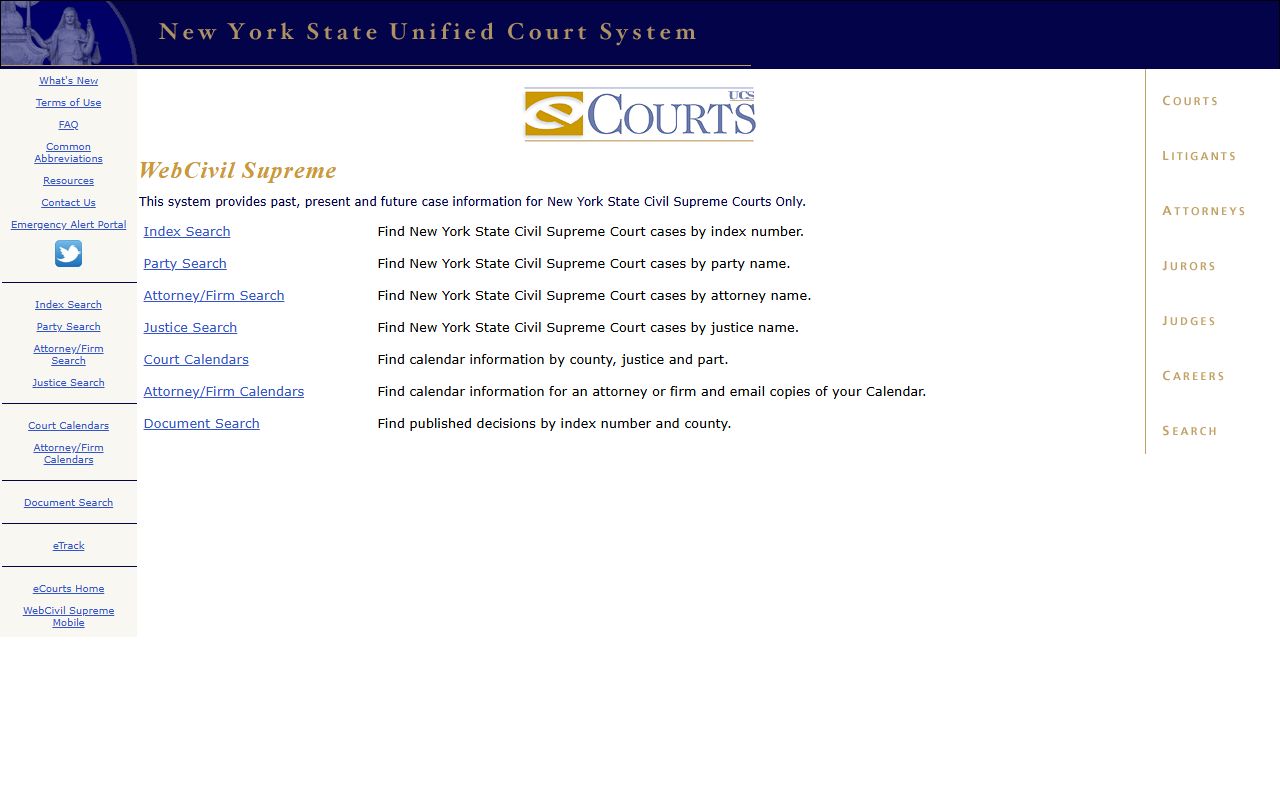
WebCivil Supreme shows index number, parties, attorneys, justice, part, status, event entries, and links to NYSCEF documents for e-filed cases. It is the primary starting point for any civil Richmond County Supreme Court records search.
E-Filing and NYSCEF in Richmond County Supreme Court
NYSCEF, the New York State Courts Electronic Filing system, is the mandatory platform for most Supreme Court civil cases in Richmond County. The 2025 expansion brought additional civil case types under the mandatory e-filing program, meaning attorneys and represented parties must file through NYSCEF rather than in paper. Unrepresented litigants are generally not required to e-file even where mandatory for attorneys, though they may opt in.
The official rule governing mandatory e-filing is Uniform Rule 202.5-bb. The mandatory program has been expanding in phases. The Second Department and Richmond County are included in the statewide rollout. Filing through NYSCEF generates instant docket entries and makes filed documents available to parties and, for public documents, to the public through NYSCEF guest search.
The mandatory Supreme Court e-filing rule was updated in 2025 with an adoption date of July 1, 2025 and an effective date of July 7, 2025, adding case types to the mandatory list statewide. The Richmond County Clerk processes NYSCEF index numbers and filing fees; the fee structure remains the same whether filing is electronic or paper.
The official rule page for the 2025 mandatory e-filing expansion is published at the NY Courts redesign site.
The Uniform Rule 202.5-bb mandatory e-filing page describes which case types are covered by the program, exemptions available, emergency hard-copy filing procedures, and service rules for NYSCEF filers.
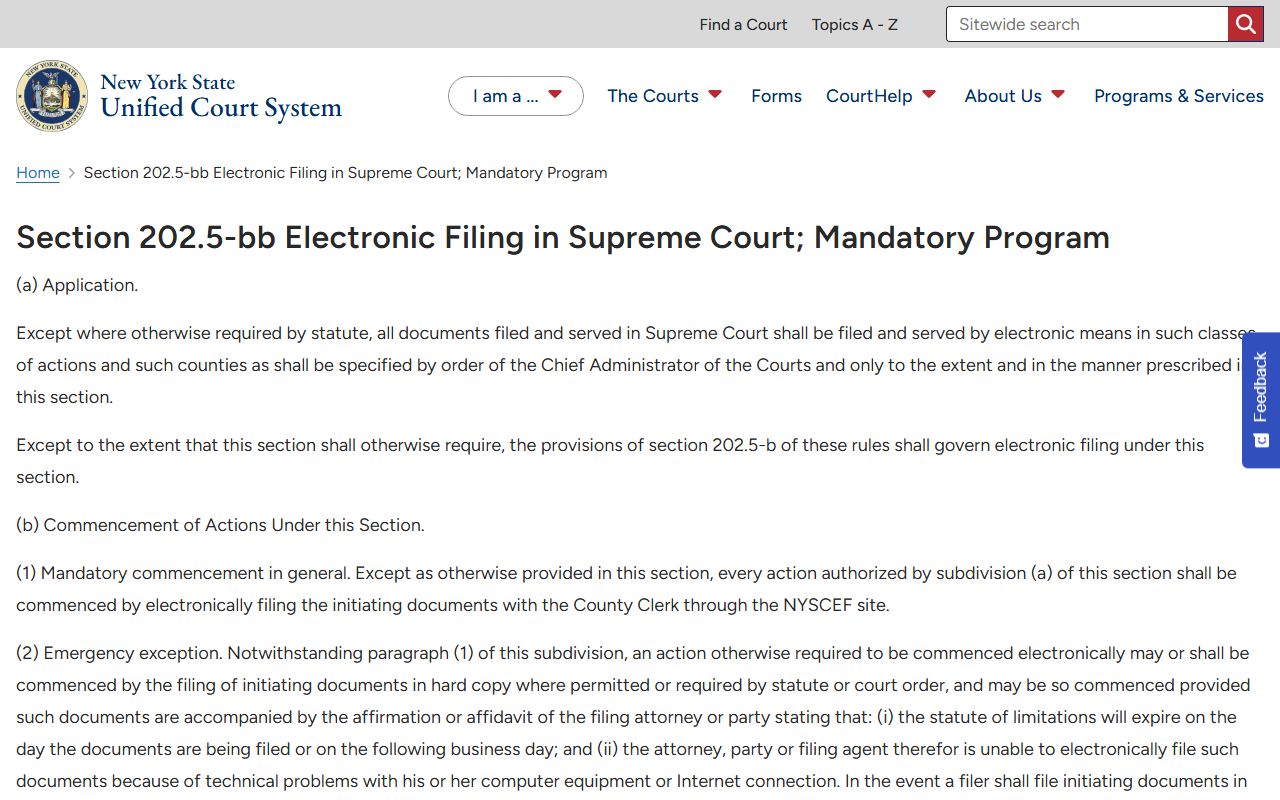
Attorneys in Richmond County Supreme Court civil cases should review the mandatory e-filing rule before filing any new action in 2025 or later, as more case types entered the mandatory program and the opt-out procedures are limited.
Free NYSCEF training is available through NY Courts. Surrogate's Court also points attorneys and self-represented parties to training resources. For guest search access to public e-filed documents, users can search without creating an NYSCEF account by clicking "Search as Guest" on the NYSCEF homepage.
How a Felony Case Moves Through Richmond County Courts
Understanding the path a felony case takes helps identify which court has the records at each stage. The process below reflects how New York criminal cases move from arrest to final disposition in Richmond County.
The flow is linear but each stage has its own clerk, its own docket entries, and its own record location. Cases do not always move at the same speed; bail hearings, motion practice, continuances, and plea negotiations all add time at different stages.
- Arrest and booking. The person is arrested by NYPD or another law-enforcement agency, processed through booking, photographed and fingerprinted, and checked for warrants.
- Arraignment in Criminal Court. The first court appearance happens in New York City Criminal Court, Richmond division. Charges are stated, bail or release conditions are addressed, and the case is assigned a docket number. Misdemeanors stay in Criminal Court. Felony charges proceed to the next step.
- Grand jury review. The Richmond County District Attorney presents felony evidence to a grand jury. If the grand jury returns an indictment, the case moves to Supreme Court.
- Arraignment in Supreme Court Criminal Term. The defendant is arraigned on the indictment in Supreme Court, Room 240. Bail conditions may be revisited. The case is now a Supreme Court matter with a new index or indictment number.
- Pre-trial motions and hearings. Suppression motions, discovery, and other pre-trial matters are handled before a Supreme Court justice in the Criminal Term.
- Trial or plea. The case resolves by guilty plea, nolle prosequi, or trial verdict in Supreme Court Criminal Term.
- Sentencing. The justice imposes sentence after conviction.
- Appeal to Appellate Division, Second Department. A convicted defendant may appeal to the Appellate Division, Second Department in Brooklyn.
- Further review by Court of Appeals. If allowed by law, the case may proceed to the New York Court of Appeals, the state's highest court.
Records at each stage live in different places. Criminal Court docket entries and arraignment records are with the Criminal Court clerk. After indictment, Supreme Court Criminal Term takes over. Sentencing records and certificates of disposition are available from the court clerk. Sealed records may be withheld at any stage under Criminal Procedure Law.
The Richmond County court dockets page explains how to read docket entries across these stages.
Appeals from Richmond County Supreme Court
Appeals from Richmond County Supreme Court go to the Appellate Division, Second Department. The Second Department covers the Second, Ninth, Tenth, and Eleventh judicial districts and sits at 45 Monroe Place in Brooklyn. Its phone is listed in the Civil Court directory as 718-875-1300. Certain Civil Court or Criminal Court appeals may route through the Appellate Term, First or Second Department, before reaching the Appellate Division.
From the Second Department, further review by the New York Court of Appeals is available only in limited circumstances, generally when the Second Department certifies a question or when a substantial constitutional question is directly involved. The Court of Appeals sits in Albany and is the state's court of last resort. Federal constitutional questions from a New York case may also reach the U.S. Supreme Court through federal-question jurisdiction.
Richmond County Supreme Court Filing Fees
Filing fees for Supreme Court matters are collected by the Richmond County Clerk. The fee schedule covers index numbers, motions, notices, certifications, and copy costs. The table below lists the fees most commonly paid by civil litigants in Richmond County Supreme Court.
| Item | Official Fee |
|---|---|
| Index Number | $210.00 |
| Third-Party Index Number | $210.00 |
| Request for Judicial Intervention (RJI) | $95.00 |
| Note of Issue (after RJI paid) | $30.00 |
| Note of Issue for Uncontested Matrimonial (incl. RJI) | $125.00 |
| Motion or Cross-motion | $45.00 |
| Motion for leave to proceed in forma pauperis | No fee |
| Jury Demand | $65.00 |
| Stipulation or Voluntary Discontinuance | $35.00 |
| Notice of Appeal | $65.00 |
| Residential Foreclosure additional fee | $190.00 |
| Certified copy of court record | $8 per document plus $0.25 per page |
| Plain copy, per page | $0.25 |
| Court records search, two consecutive years | $5.00 |
The full fee schedule is published at richmondcountyclerk.com. The Richmond County Clerk page covers the clerk office's full role, contact information, and the county-record fee schedule that applies to liens, judgments, and business certificates.
Fee waivers may be available for people with financial hardship. Ask the clerk about the in forma pauperis process and the required forms. Filing a fee-waiver motion costs nothing.