
How to Search Richmond County Court Records
Court records in Richmond County are split by court type, so the search starts with a question: what kind of case is it? The statewide gateway is NYS eCourts, run by the New York State Unified Court System. From there you can reach the tools that cover civil, criminal, family, and estate matters. Land and county records sit in a separate place, the Richmond County Clerk's land-document portal.
Before you start, gather what you know. A party name, an index or docket number, and the court type all help. Names should be spelled the way the court would have them, and a business may appear under a name that differs from its trade name.
- Open eCourts and pick the tool that matches the case type.
- Use WebCivil Supreme for Supreme Court civil and divorce cases, or WebCivil Local for Civil Court, housing, and small claims.
- Use WebCriminal for pending criminal cases with a future court date, and choose a Richmond court from the dropdown.
- Use WebSurrogate for estates and wills, and WebFamily for active Family Court matters.
- If the file is not online, request a copy from the Clerk of the Court or the County Clerk that holds it.
The eCourts landing page lists every public tool in one spot, which makes it the safest starting point when you are not sure where a case lives. The screenshot below shows that gateway.
This view of the New York eCourts gateway shows the WebCivil, WebCriminal, WebFamily, and WebSurrogate options side by side.
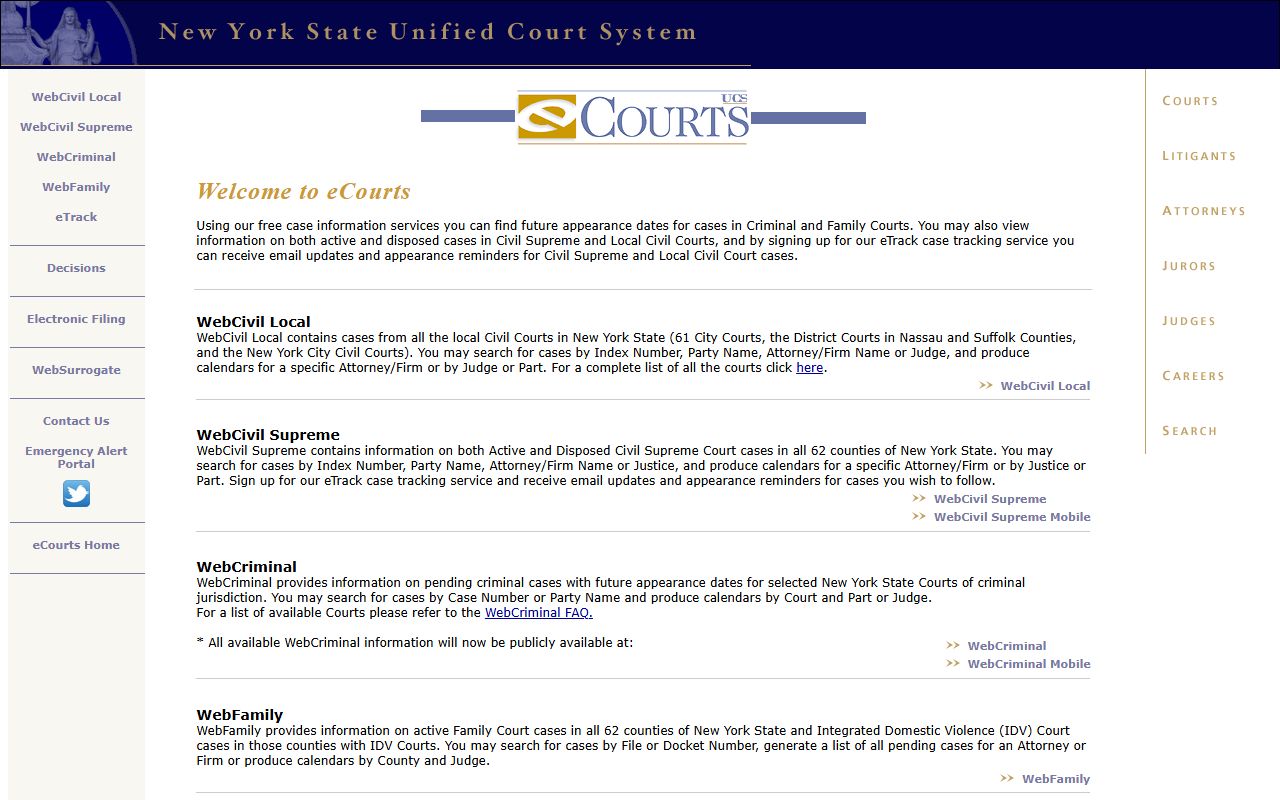
Each link there opens a separate database, so a name typed into one tool will not pull a case that lives in another. Pick the court first, then search.
Richmond County Court Records Search Fields
The main civil search tool, WebCivil Supreme, offers several ways to look up a Richmond County Supreme Court case. You can search by index number, party, attorney or firm, or assigned justice, and you can pull court calendars. The table lists the search modes the portal provides.
| Search Mode | Type | What It Does |
|---|---|---|
| Index Search | Index number | Finds a case by its Supreme Court index number. |
| Party Search | Name | Finds cases by a party name. |
| Attorney/Firm Search | Name | Finds cases tied to an attorney or firm. |
| Justice Search | Name | Finds matters before a named justice. |
| Court Calendars | Calendar | Lists calendars by county, justice, and part. |
| eTrack | Service | Sends email updates and appearance reminders. |
WebCivil Supreme gives past, present, and future case information for New York civil Supreme Court matters only. Lower civil cases use WebCivil Local, which works in much the same way.
The Richmond County Judicial System
Richmond County sits in the 13th Judicial District. Its main trial court is the Supreme Court, which hears higher-dollar civil cases, divorce and other matrimonial actions, foreclosures, and felony criminal prosecutions through its Criminal Term. A felony arrest may first appear in Criminal Court for arraignment, then move to Supreme Court Criminal Term after indictment.
Lower civil matters, housing cases, and small claims go to the New York City Civil Court branch on Staten Island. Family matters such as custody, support, and child protection go to Family Court. Estates and wills go to Surrogate's Court. Appeals from these trial courts generally route to the Appellate Division, Second Department, with the Court of Appeals as the highest state court.
Case flow: Criminal Court › Supreme Court Criminal Term › Appellate Division, Second Department › Court of Appeals
| Court | Jurisdiction | Case Types |
|---|---|---|
| Supreme Court | General trial court | Major civil, divorce, foreclosure, felony criminal |
| Civil Court | Up to $50,000 | Civil claims, housing, small claims to $10,000 |
| Criminal Court | Lower criminal | Misdemeanors, violations, arraignments, summons |
| Family Court | Children and families | Custody, support, abuse/neglect, juvenile |
| Surrogate's Court | Estates | Probate, administration, guardianship, adoption |
The state ties these tools together on one public page. The NYS e-Courts gateway links case search, decisions, eTrack, e-filing, and traffic ticket payment in a single hub.
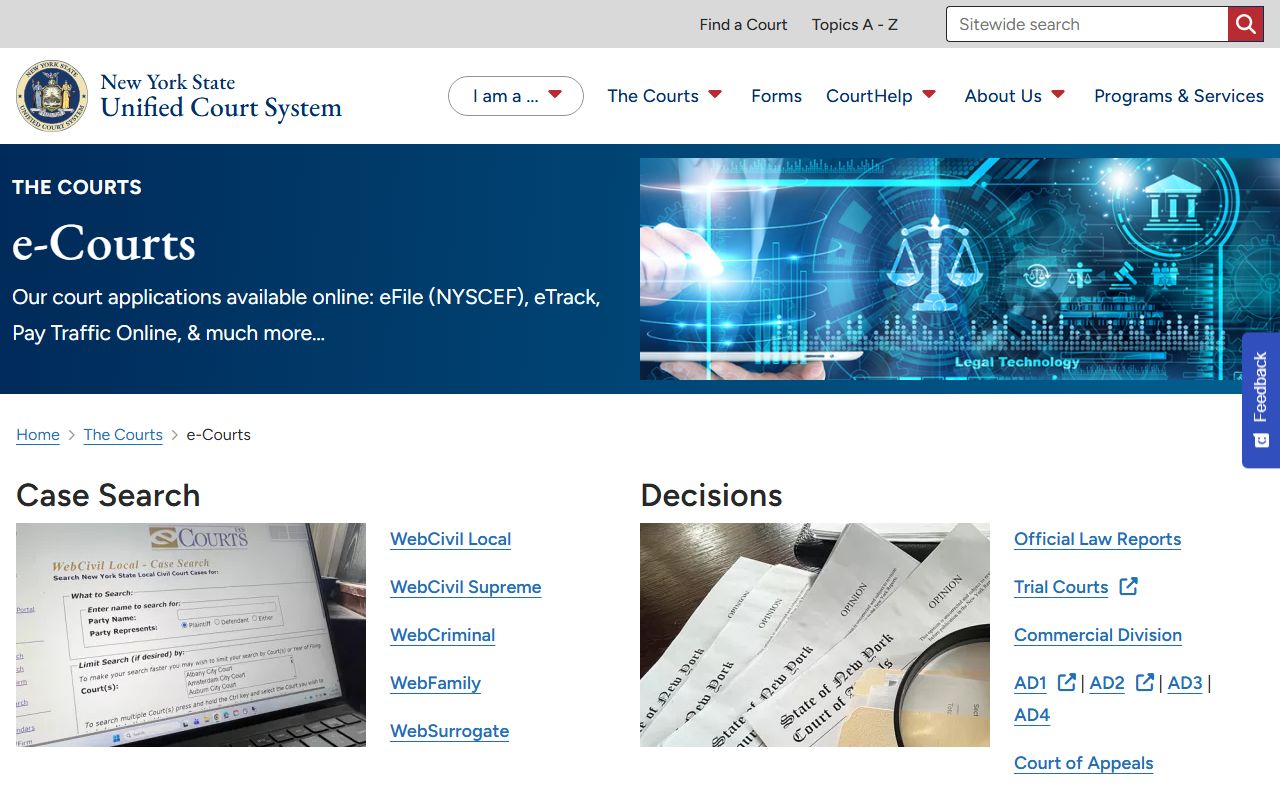
A fuller breakdown sits on the Richmond County Supreme Court page.
Which Court Holds Your Case
People often go to the wrong building because they expect one courthouse and one counter. Richmond County does not work that way. The comparison below sorts the most common needs by court and by the online tool that fits.
| Your Matter | Court | Online Tool |
|---|---|---|
| Divorce or big civil suit | Supreme Court | WebCivil Supreme / NYSCEF |
| Small claims or eviction | Civil Court | WebCivil Local |
| Misdemeanor or pending criminal | Criminal Court | WebCriminal |
| Custody or child support | Family Court | WebFamily |
| Will or estate | Surrogate's Court | WebSurrogate |
| Deed, lien, judgment | County Clerk | Land Documents Search |
For criminal matters, see the Richmond County Criminal Court page. For lower civil and housing cases, see the Richmond County Civil Court page.
Richmond County Courthouses
The county's courts spread across the St. George civic area and beyond. Supreme Court is at 26 Central Avenue. Family Court and Surrogate's Court share 18 Richmond Terrace. Civil and Housing Court sits apart, at 927 Castleton Avenue. The County Clerk and the District Attorney are tied to 130 Stuyvesant Place. Check the address before you travel.
The official Richmond County Supreme Court page confirms the Central Avenue address and notes that all visitors pass through a magnetometer.
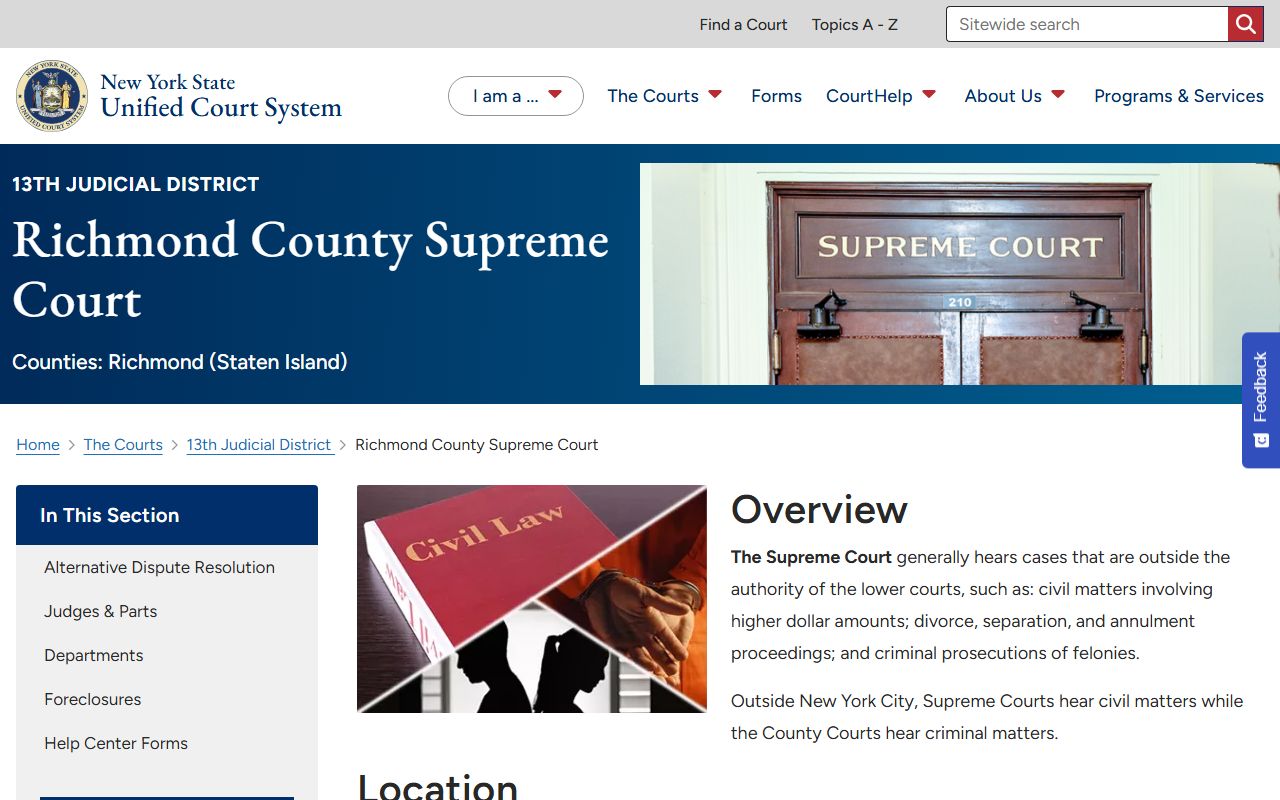
That page also lists the court's administration, including Administrative Judge Hon. Raymond L. Rodriguez and Chief Clerk Kenneth Fay.
The Supreme Court building sits in St. George near the ferry, as the map of 26 Central Avenue shows.

Family Court and Surrogate's Court are a short walk away on Richmond Terrace, while Civil Court sits farther out on Castleton Avenue.
Types of Court Records Available in Richmond County
Richmond County court records cover a wide range. Each court produces its own files, and access depends on the case type and on confidentiality rules. The list below groups the main kinds you can look for.
- Civil records - summons, complaints, motions, orders, and judgments from Supreme Court and Civil Court.
- Criminal records - indictments, pleas, dispositions, and sentencing from Criminal Court and Supreme Court Criminal Term.
- Family records - custody, support, and child-protection files, most of them confidential.
- Probate records - wills, estate administration, and guardianship from Surrogate's Court.
- Traffic records - tickets, summonses, and criminal traffic cases such as DWI.
Land documents, liens, and business certificates are county clerk records, not court dockets. Use the Richmond County Clerk page for those.
What Richmond County Court Records Show
A court record is more than a name and a number. Most files share a common set of fields, whether the case is civil, criminal, or probate. The table walks through the fields you are most likely to see in a public search result.
| Field | What It Shows |
|---|---|
| Index / Docket Number | The number that identifies the case in its court. |
| Filing Date | When the action or proceeding began. |
| Parties | Plaintiff and defendant, or petitioner and respondent. |
| Case Type | Civil, matrimonial, foreclosure, felony, support, probate. |
| Disposition | Active, disposed, dismissed, settled, or judgment entered. |
| Judge / Part | The assigned jurist and the courtroom part. |
Some fields are redacted by rule. Social Security numbers, financial account numbers, and minor names are kept out of public papers under court rules.
Public Access Laws for Richmond County Court Records
New York splits access into three buckets: agency records, court case files, and sealed or confidential records. The Freedom of Information Law, or FOIL, covers agency records. Court files follow Judiciary Law, court rules, and specific confidentiality statutes. The key laws are noted below in plain English.
Key Statutes:
Public Officers Law Article 6 (FOIL) - sets open access to government agency records, with request, appeal, and exemption rules.
Judiciary Law § 255 - requires court clerks to search their files and certify the result when fees are paid.
Public Officers Law Article 6-A - the Personal Privacy Protection Law, which governs state agency personal-data systems.
CourtHelp explains that a statewide criminal history search, or CHRS, runs $95 per search, and that FOIL is for agency administrative records rather than sealed court files.
Records That Are Restricted or Confidential
Not every record is open. New York restricts whole categories of court files to protect children, victims, and people whose cases ended in their favor. Family Court matters, adoption files, sealed criminal cases, youthful offender records, and matrimonial papers are all limited.
To view a sealed record, a person usually files a motion or petition in the court that holds it, and the district attorney may get notice and a chance to object. A sealed record is not always destroyed; it may still reach law enforcement, courts, or licensing agencies under statutory exceptions. The arrest records page covers sealing in more depth.
Specialty Courts in Richmond County
Richmond County uses problem-solving and diversion programs alongside its regular courts. The District Attorney's office runs an Alternatives to Incarceration Unit that helps people with substance use or mental health needs address the roots of criminal behavior, and it manages a Mental Health Treatment Court pathway with the Staten Island Advocacy Center.
The office also created a Domestic Violence Bureau in 2016, using vertical prosecution so one prosecutor stays with a case from start to finish. A Juvenile Justice Unit reviews crimes by people under 18 and coordinates youth matters with the Youth Part. Entry into these programs is not automatic; ask defense counsel or court staff.
Searching for Staten Island Inmates
Richmond County does not run a county sheriff's jail roster the way many non-NYC counties do. Staten Island is inside New York City, so local jail custody is handled by the New York City Department of Correction. The official tool is the NYC DOC Person in Custody Lookup, which shows current city custody and basic case information.
For state prison, use the DOCCS lookup; for federal custody, use the BOP locator; for release alerts, use VINELink. Full details sit on the Richmond County inmate records page, with warrant records and released inmates covered separately.
Marriage, Divorce, and Surrogate's Court
Marriage licenses on Staten Island come from the NYC City Clerk and the Marriage Bureau, not the courts. Divorce is a Supreme Court matter, filed through the County Clerk. Wills and estates go to Surrogate's Court. See the marriage and divorce records page and the Surrogate's Court page for the steps and fees.
- Testator
- The person who made a will.
- Executor
- The person named in a will to carry out the estate.
- Intestate
- Dying without a valid will.
- Letters Testamentary
- The court order that gives an executor authority to act.
Richmond County Court Records Fees
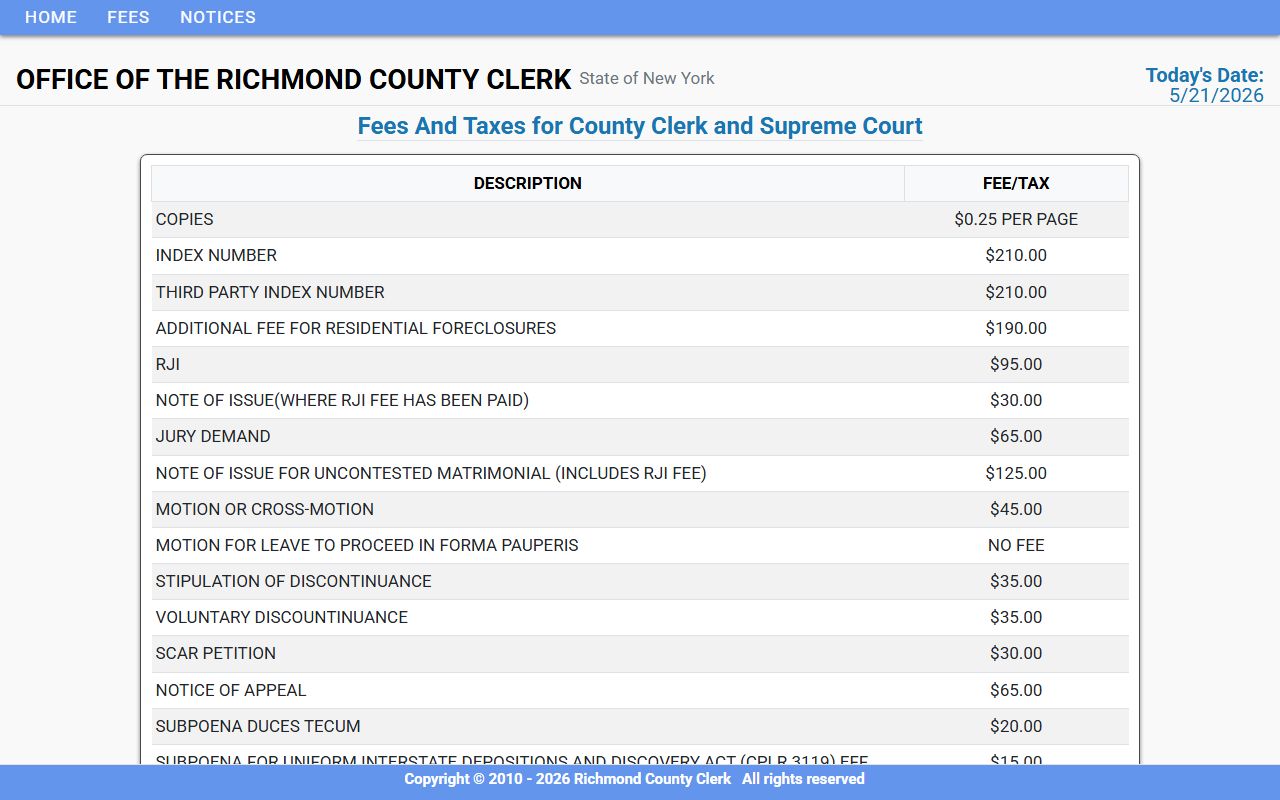
The Richmond County Clerk publishes a fee schedule that covers both Supreme Court filings and county records. Copies run a flat per-page rate, and certified copies add a per-document fee. The most common charges are listed below.
| Item | Amount |
|---|---|
| Copies, per page | $0.25 |
| Certified copy of a court record | $8 per document plus $0.25 per page |
| Certified copy of a county clerk record | $10 per document plus $0.25 per page |
| Court records search, two consecutive years | $5 |
| Index number | $210 |
You can confirm these on the Richmond County Clerk fee page, which lists dozens more, including motions, notes of issue, and business certificates.
Land records carry their own fees and are searched through the clerk's Land Documents Search portal, shown below.
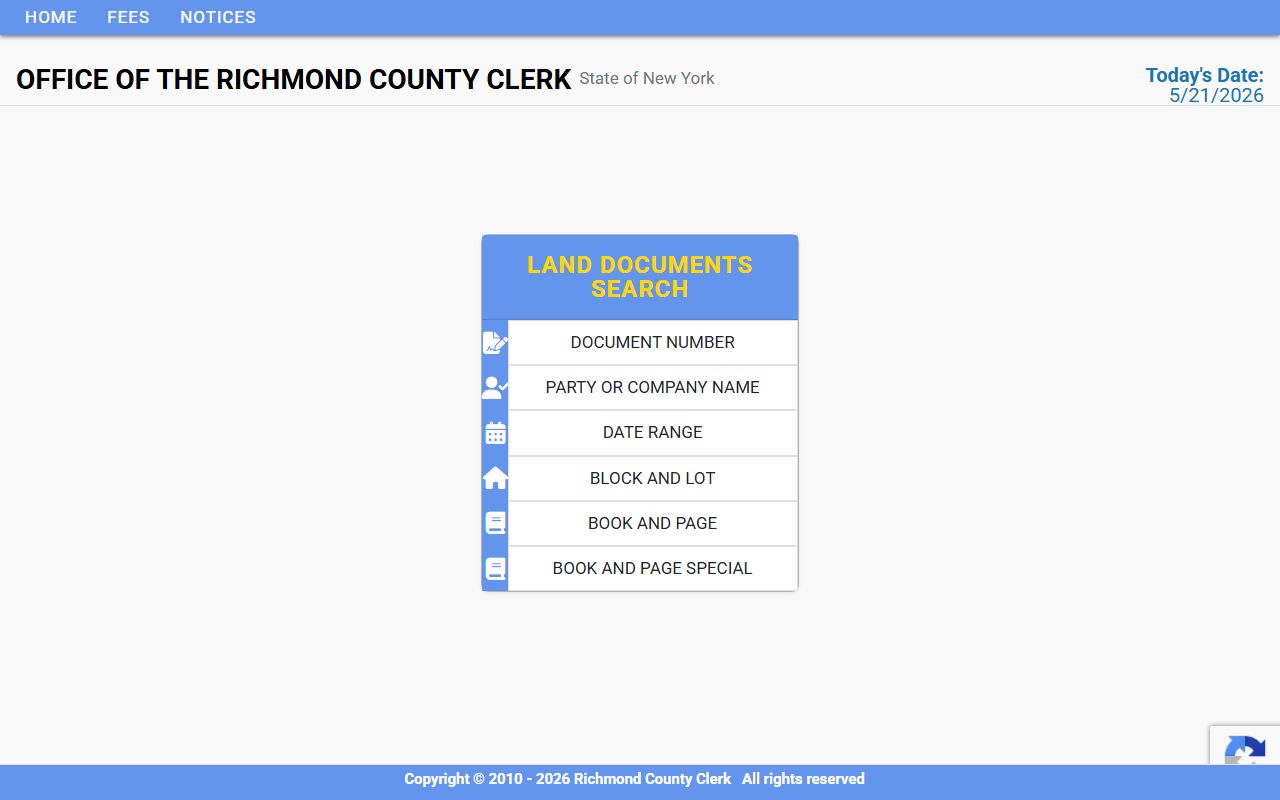
That menu searches by document number, party or company name, date range, block and lot, or book and page, which is useful for deeds, mortgages, and liens rather than court dockets.
How to Interpret Richmond County Court Records
Records use shorthand that can trip up first-time readers. An index number is a civil Supreme Court case number bought through the County Clerk. A docket number tags many criminal, family, and lower-court cases. A disposition is the outcome or current status, such as dismissed, settled, or judgment entered.
One point matters most. An arrest or a charge is not a conviction. WebCriminal shows pending cases with a future date, not a full criminal history, so a result there does not prove guilt. A certificate of disposition from the clerk is the document that confirms how a criminal case ended.
Self-Help and Legal Aid in Richmond County
Help is available for people without a lawyer. NY CourtHelp offers statewide self-help, and the Richmond Surrogate's Court Help Center and the Civil Court Help Center assist with forms and procedure, though they cannot give legal advice. Several outside groups also help residents find counsel.
One starting point is LawHelpNY, a statewide referral and self-help resource for civil matters.

For direct civil legal services across the city, residents can turn to Legal Services NYC, which handles housing, family, benefits, and consumer cases.

Jurors can report and check status through the New York juror services portal.
Recent Changes Affecting Richmond County Records
Record access keeps shifting. In 2025, New York expanded mandatory e-filing in Supreme Court Civil Term to more case types statewide, which pushes more Richmond County civil files through NYSCEF and its guest search. That means more documents online, but sealing and matrimonial limits still apply.
Note: Online records can lag behind the courthouse, so confirm key details with the clerk that holds the file before you rely on them.
Frequently Asked Questions
Is New York Supreme Court the highest court?
No. New York uses Supreme Court as the name of its main trial court of general jurisdiction. The state's highest court is the Court of Appeals. In Richmond County, Supreme Court sits at 26 Central Avenue and handles major civil cases, divorce, and felony prosecutions through its Civil and Criminal Terms.
Where is the Richmond County courthouse?
There is more than one. Supreme Court is at 26 Central Avenue. Surrogate's Court and Family Court are at 18 Richmond Terrace. Civil and Housing Court is at 927 Castleton Avenue. The County Clerk and District Attorney are tied to 130 Stuyvesant Place in the St. George area.
How do I find an inmate arrested in Richmond County?
Use the NYC Department of Correction Person in Custody Lookup for current city jail custody, since Staten Island has no separate county roster. Use DOCCS for state prison, the BOP locator for federal custody, and VINELink for release alerts.
More on the Richmond County Court Records FAQ page.